 Skip to content
Introduction
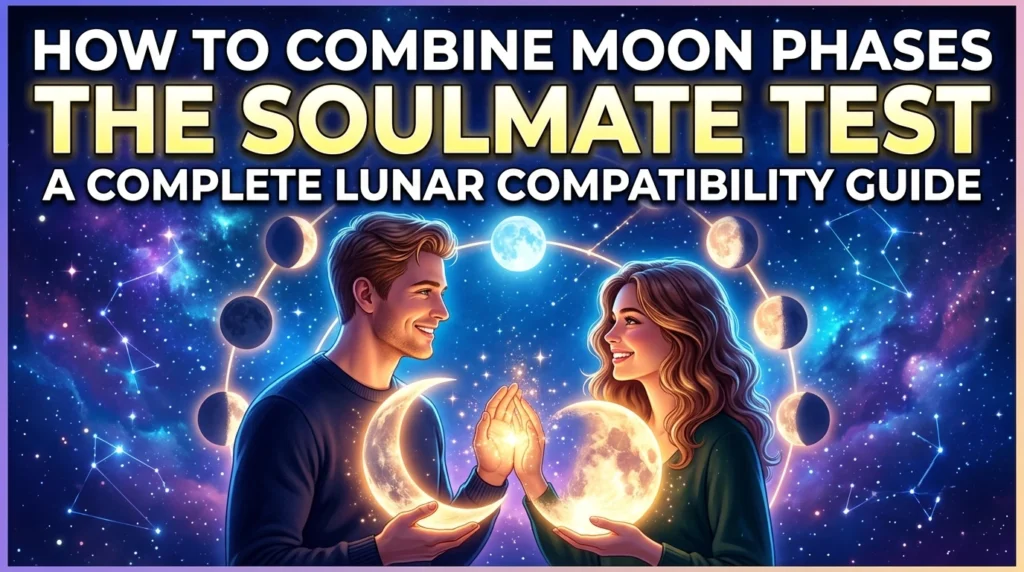
Quick answer: To combine moon phases for the soulmate test, find each person’s birth moon phase, then layer the two lit shapes together — phases that complete each other’s disc are read as a strong, complementary match. Try it yourself with the Moon Phase Soulmate Calculator, which finds both phases from two birth dates and shows the pairing. This guide walks through every step, the full 64-pairing chart, and a worked example, so you can read your own result with confidence. Treat it as a reflective tradition and a bit of fun, not a scientific verdict on a relationship. Every relationship carries a hidden emotional rhythm — one quietly shaped by the lunar energy present at birth. The moon phase you were born under holds a lunar phase blueprint, revealing how you feel, love, and process feelings at your deepest sense of belonging.
Most people chase compatibility through Sun sign matches, but synastry within lunar astrology runs far deeper. Your natal moon phase — sometimes called your birth moon or moon sign snapshot — defines your emotional core: the instinctive lens through which you connect emotionally, communicate emotionally, and ultimately align with a partner.
The moon phase soulmate test is rooted in astrological tradition, drawing from thousands of years of relationship dynamics study. By comparing birth moon phases, you uncover an energetic correlation that reveals emotional balance, spiritual bond, and the potential for long-term relationship harmony between two people.
What makes this compatibility test genuinely compelling is its symbolic balance — two lunar birth phases that form a complete circle suggest wholeness. Whether a new moon meets a full moon or a waxing gibbous mirrors a waning gibbous, the lunar connection speaks to something profoundly spiritual and emotional simultaneously.
Unlike a standard Sun-sign or zodiac compatibility check, this method looks specifically at lunar synastry — how the moon’s position at each partner’s birth interacts across a shared astrological wheel. That distinction matters, because in astrology, the moon (not the sun) is considered the ruler of emotional needs, attachment style, and inner security.
What Is a Moon Phase Soulmate?
The concept of a moon soulmate isn’t rooted in TikTok alone — it traces back to astrological tradition, where lunar phases were believed to imprint emotional patterns onto people at their moment of birth, shaping relational instincts.
Unlike conventional astrology, this idea proposes that your personal moon phase acts as an emotional blueprint — a cosmic connection that defines not just your inner world but the deep emotional frequency you carry into every romantic encounter.
What makes someone a moon phase soulmate is complementary energy — two people whose birthday lunar snapshots either mirror or balance each other’s emotional needs, creating either harmony through sameness or wholeness through opposing energetic pulls.
I’ve seen this symbolic tool resonate with people seeking reflection beyond surface-level compatibility. It’s less about destined fate and more about recognizing spiritual bond patterns that help you understand your own emotional relational language more precisely.
In practice, most compatibility calculators sort these connections into recognizable relationship dynamics: conjunct (same phase, shared rhythm), sextile (supportive, easygoing), trine (natural flow and ease), square (friction that sparks growth), and opposition (the classic New Moon–Full Moon soulmate pairing). Some traditions also include an aversion aspect, where two moon phases share little direct relationship at all, which can point to partners who simply process emotion in unrelated ways.
The 8 Moon Phases & Their Personalities
Each lunar phase carries a distinct spiritual energy that shapes how people express love, perceive connection, and relate emotionally. From new moon beginnings to the full moon’s emotional peaks, every phase holds a unique personality that practitioners study through the branch of astrology known as lunar synastry.
Understanding your vibe within the lunar energy spectrum reveals surprising truths about relationships. The First Quarter moon produces driven, action-first personalities, while waning gibbous types are reflective and wisdom-oriented — each phase creating harmony that blends beautifully with specific emotional temperaments and a deeper level of self-awareness.
Illumination during the Full Moon phase creates naturally intense, emotionally resonant people who devote deeply to those they love. New Moon personalities, by contrast, operate on quiet new-beginnings energy, drawn toward soul ties and patient, spiritual growth within their relationships and inner lives.
What makes this astrological concept remarkable is how planetary positions at birth imprint lasting emotional patterns. A passionate First Quarter individual paired with a lunar energy-sensitive partner demonstrates the natural astrological connection that astrology practitioners have long described as foundational to compatible bonding.
For a complete picture, here’s how all eight lunar birth phases typically express emotionally in relationships:
| Moon Phase | Core Emotional Trait | Relationship Style |
| New Moon | Visionary, intuitive, new beginnings | Seeks soul ties; patient, quiet emotional growth |
| Waxing Crescent | Hopeful, curious, momentum-driven | Thrives with encouragement and shared goals |
| First Quarter | Driven, action-first, decisive | Wants a partner who matches their pace and ambition |
| Waxing Gibbous | Detail-oriented, refining, perfectionist | Values honest feedback and steady effort |
| Full Moon | Intense, illuminated, emotionally expressive | Devotes deeply; needs reciprocity and recognition |
| Waning Gibbous | Reflective, wise, communicative | Builds bonds through intellectual and emotional depth |
| Last Quarter (Third Quarter) | Transformative, release-oriented | Needs a partner comfortable with change and honesty |
| Waning Crescent | Introspective, spiritual, restorative | Draws closeness through quiet vulnerability |
Moon Phase Compatibility Pairings / Best Matches
The New Moon and Full Moon pairing stands as the classic soulmate pairing in lunar astrology — a complete circle of emotional energy where opposing phases harmonize naturally, creating profound resonance between two deeply spiritual individuals seeking new beginnings. In synastry terms, this is an opposition aspect (roughly 180° apart on the lunar cycle).
First Quarter individuals paired with waning gibbous personalities build relationships rooted in intellectual reciprocity — one ambitious and action-forward, the other wise and reflective, their combined lunar energy producing a deeper level of mutual curiosity and shared values. This pairing often reflects a square or trine dynamic, depending on exact birth timing.
Waxing crescent Moon partners thrive alongside values-driven souls who devote genuine attention to soul ties — these pairings naturally blossom through new experiences, where one brings bold vision, and the other offers stability, security, and grounded emotional support.
The astrological concept behind natural astrological connection suggests passionate bonds form when illumination levels differ by roughly 3.5 days — astrology practitioners observe that personality contrasts within an eight-phase framework actually express love more sustainably long-term. This is closely related to what synastry calls a sextile relationship — close enough to feel familiar, different enough to stay interesting.
Moon Phase Soulmate Vs. Twin Flame
While many seek a Moon phase soulmate test to find emotional ease, identifying a twin flame involves a mirror connection. This intense bond often feels unstable or controversial, acting as a transformative catalyst for growth.
Soulmate compatibility suggests complementary energy and harmony, whereas the other path triggers friction. This New Age phenomenon can sometimes mask toxic behavior, so look for strong bonds that provide once-in-a-lifetime peace rather than chaos.
Unlike matching moon phases that offer a good match and spiritual pulling, the mirror path is often intense. A free moon soulmate test might reveal spiritual bondings, but true inner growth requires emotional maturity.
Whether you find a partner via New Moon or Full Moon alignments, focus on emotional resonance. Real spiritual pullings create rhythmic stability, while the alternative often demands a difficult, albeit necessary, personal evolution for seekers.
Quick distinction: a moon phase soulmate offers ease and complementary energy; a twin flame connection tends to mirror your own unresolved patterns back at you, which is why it can feel simultaneously magnetic and destabilizing.
Is The Moon Phase Soulmate Test Accurate / Scientific?
The validity of this astrology trend relies on synastry, though no peer-reviewed studies confirm or deny it. Critics cite placebo effects and unproven science, yet astrology practitioners find deeply personal and insightful guidance through lunar influences.
Modern astronomical algorithms and historical lunar almanac data power the mechanism, ensuring accurate moon phase calculations. While scientifically proven results remain elusive, the energetic correlation offers a unique perspective for self-reflection on relationship dynamics.
Digital compatibility analysis uses an 8-phase framework to reflect personalities. Beyond entertainment, these astrological beliefs highlight emotional needs and communication. One’s birth date calculator results provide fun insights without being the sole determining factor.
Experts suggest lifestyle compatibility, communication style, and shared values outweigh moon phase data for harmonious connections. Use the moon phase compatibility test as a thought-provoking tool for awareness, not a verdict on your relationship’s future. Genuine connections flourish through mutual respect and emotional maturity regardless of what your natal chart says.
How the Calculator Works (Technical)
Calculations start with the two birth dates, which are matched against the lunar cycle to identify each person’s moon phase at birth. A birth time can help when a date falls near a phase boundary, but the calculator on this site works from birth dates, not an exact time or city-level location. The point is a clear, readable phase for each person, so the two phases can then be compared. Or try the Moon Phase Compatibility Test (TikTok version) for the viral trend format.
The lunar calculator then utilizes a mechanism to compare your Moon phase against a partner’s. This compatibility calculator measures the lunar correlation between eight Moon phases — expressed as an angular distance in degrees — generating a compatibility score for soulmates.
To layer the results, some users screenshot moon phase images from a reputable moon phase lookup tool. Using a photo editor, you can overlay these visuals side by side to visually confirm whether the two phases complete a full moon shape together.
While modern science lacks scientific proof to confirm or deny validity, this astronomical-factors analysis offers emotional insight. It serves as a tool for self-reflection on emotional chemistry and spiritual compatibility between birthdates — much like a simplified entry point into full synastry chart reading.
What If Your Moon Phases Don’t Align?
Experiencing different moon phases within a partnership shouldn’t signal obstacles. Instead, view this as a unique relationship opportunity where shared values and love bridge the gap. Individual effort creates a beautiful, lasting alignment.
Expertise suggests that strong bonds thrive when partners prioritize communication. You can complement each other’s shadows, using understanding to foster compatibility. Such a balance often yields deeper growth than a perfectly mirrored lunar reflection.
Many factors shape a relationship beyond simple lunar geometry — communication, shared values, and everyday effort among them. If you choose to put in effort together, even mismatched cycles can provide a strong foundation. Your love is a choice, not just a star map.
Ultimately, compatibility is forged through daily understanding and communication. While different moon phases exist, they often complement personalities, creating a balance that sustains a healthy relationship. Your shared values define the future, regardless of what phase either of you was born under.
Moon Phase Compatibility As A Tool For Self-Reflection
Analyzing your core moon phase offers a unique analytical perspective on emotional patterns. Instead of seeking a perfect couple status, use moon phase observation to grow, identifying emotional triggers that shift across the eight phases.
Internal self-improvement begins by mapping lunar cycles to personal significance. This new age phenomenon reveals how introverted tendencies or an adventurous personality evolve through effort, providing guidance for natural alignment and long-term relationship potential.
By examining lunar gravity and moonlight as metaphors for spiritual pulling, we decode relationship dynamic nuances. Understanding moon phase differences helps fulfill internal needs, transforming insecure moments into true security and emotional fulfillment.
Scientific analysis suggests placebo effects often drive cosmic compatibility perceptions. However, treating moon phase names as a compatibility framework allows for open communication, helping individuals complement each other while navigating different paths toward unity.
Frequently Asked Questions
What is a moon phase soulmate?
Your moon relationship creates spiritual bondings across eight moon phases, defining a true, celestial soulmate alignment.
Can opposite moon phases attract each other?
Opposite Moon phases often attract, creating emotional stability and completion within a soulmate match — this is the classic New Moon–Full Moon opposition pairing.
Does your core moon phase ever change?
Lunar identity is fixed; though the eight Moon phases cycle continuously, your natal moon phase — set at the moment of your birth — remains constant throughout your life.
How is the moon phase soulmate test different from zodiac sign compatibility?
Zodiac or Sun-sign compatibility looks at core identity and general personality, while moon phase compatibility zeroes in specifically on emotional needs, attachment patterns, and how you process feelings within a relationship — making it a more intimate layer of synastry.
Do I need my exact birth time to calculate my moon phase?
Because the moon moves quickly, a general birth date is often enough to identify your broad phase, but an exact birth time improves accuracy, especially if you were born near a transition between two phases.
The Complete 64-Pairing Compatibility Chart
There are eight moon phases, so there are 8 x 8 = 64 possible pairings. You do not need to memorise all of them. Find your phase down the left column, find your partner’s phase across the top, and read the range where they meet. The range names below are the ones used throughout this guide.
Steps apart, and what each range means
Count the shortest distance between the two phases around the eight-phase cycle, in steps of one phase. That distance gives you the range.
| Steps apart | Range | How it tends to feel |
| 0 | Conjunct | Same phase, shared rhythm; you understand each other quickly. |
| 1 | Sextile | Supportive and easygoing; different enough to stay interesting. |
| 2 | Square | Friction that can spark growth, if you talk through it. |
| 3 | Trine | Natural flow and ease; things tend to fall into place. |
| 4 | Opposite | Completion and contrast; the two halves of one disc. |
One more label appears in older tradition: Aversion. It is not a step count. It describes a pairing that feels like it has little direct relationship at all — not tense, not easy, just unrelated, as if you process emotion in different languages. Some readers use it when a pairing does not clearly fit the five ranges above. If your pairing ever feels that way, the honest reading is not that the relationship is doomed; it is that this particular lens gives you less to work with, and the rest of the relationship has to do more of the talking.
The full pairing matrix
Read across from your phase to your partner’s phase. The matrix is symmetrical, so it does not matter who is listed first.
| New Moon | Waxing Crescent | First Quarter | Waxing Gibbous | Full Moon | Waning Gibbous | Last Quarter | Waning Crescent | |
| New Moon | Conjunct | Sextile | Square | Trine | Opposite | Trine | Square | Sextile |
| Waxing Crescent | Sextile | Conjunct | Sextile | Square | Trine | Opposite | Trine | Square |
| First Quarter | Square | Sextile | Conjunct | Sextile | Square | Trine | Opposite | Trine |
| Waxing Gibbous | Trine | Square | Sextile | Conjunct | Sextile | Square | Trine | Opposite |
| Full Moon | Opposite | Trine | Square | Sextile | Conjunct | Sextile | Square | Trine |
| Waning Gibbous | Trine | Opposite | Trine | Square | Sextile | Conjunct | Sextile | Square |
| Last Quarter | Square | Trine | Opposite | Trine | Square | Sextile | Conjunct | Sextile |
| Waning Crescent | Sextile | Square | Trine | Opposite | Trine | Square | Sextile | Conjunct |
A Worked Example: Combining Two Real Birth Dates
Take Maya, born 14 March 1995, and Daniel, born 18 October 1998. Run both dates through the Moon Phase Soulmate Calculator and you get Waning Crescent for Maya and Waxing Gibbous for Daniel. Here is how to combine them by hand.
First, picture the two lit shapes. A Waning Crescent is a thin sliver of light on the waning side of the cycle; a Waxing Gibbous is a large, nearly full lit shape on the waxing side. Layer them and the lit parts fill in almost the whole disc, with only a small gap left over. That is the visual idea behind the trend: two shapes that complete each other.
Next, count the steps. In the eight-phase order — New Moon, Waxing Crescent, First Quarter, Waxing Gibbous, Full Moon, Waning Gibbous, Last Quarter, Waning Crescent — Waxing Gibbous sits at position 4 and Waning Crescent at position 8. The shortest distance between them is 4 steps, so the range is Opposite. The calculator agrees, labelling this pair Celestial Opposites with an 89% Cosmic Match score. Remember, that score is the calculator’s symbolic way of describing the pairing, not a probability that the relationship will succeed.
For a fuller explanation of what each part of a result means, see what the moon phase soulmate test is, how it works, and what your result means, and for a step-by-step walkthrough, see how to find your moon phase soulmate.
Phases That Don’t Complete Each Other: Partial Overlays
Most pairings do not form a perfect disc, and that is normal. A partial overlay simply means the two lit shapes overlap in places and leave gaps elsewhere. In range language, a Conjunct pairing (same phase) doubles the same shape, so the overlay is identical rather than completing; a Sextile or Trine pairing overlaps gently and leaves a clear gap; a Square pairing overlaps awkwardly, which is why it is read as friction.
None of this is a failing grade. A partial overlay is best read as a conversation starter: where do the shapes overlap, and where does each person bring something the other does not? If the overlay looks identical, you may share a rhythm but need to watch for shared blind spots. If it barely overlaps at all, you may process emotion quite differently, and the relationship will lean more on communication and shared values. The disc is a picture to reflect on, not a pass-or-fail test.
More Questions About Combining Moon Phases
How do I count steps apart?
Put the eight phases in order, count the shortest way around the cycle from one phase to the other, and use the mapping table above: 0 is Conjunct, 1 is Sextile, 2 is Square, 3 is Trine, and 4 is Opposite.
What if our phases are the same?
That is a Conjunct pairing. The overlay is identical, so the reading is shared rhythm and easy understanding, with a note to watch for the same blind spots showing up twice.
Does the order of the two birth dates matter?
No. The pairing matrix is symmetrical, so swapping who goes first gives the same range and the same overlay reading.
Can I combine phases without the calculator?
Yes, once you know both birth phases. Find them with the Moon Phase Soulmate Calculator or any reliable moon phase lookup, then use the chart in this guide. If you enjoy the visual version, the moon phase soulmate trend shows how people layer the two phase images on social media.