 Skip to content
Introduction
The moon cycles through its phases with quiet precision — yet most people overlook the new moon entirely. This astronomical event carries far more significance than casual observers realize, shaping everything from ocean tides to ancient calendars.
Each lunar cycle begins at conjunction, when the Sun and Moon share the same ecliptic longitude. At this moment, the Moon’s night side faces Earth, making it essentially invisible to the naked eye. Yet its influence is anything but absent.
The synodic month — the time from one new moon to the next — spans approximately 29.53 days and has governed:
- Tidal forces and ocean behavior
- Biological rhythms in plants, animals, and humans
- Calendar systems across civilizations, from the Islamic Hijri calendar to the Hebrew lunisolar calendar
What Is the New Moon?
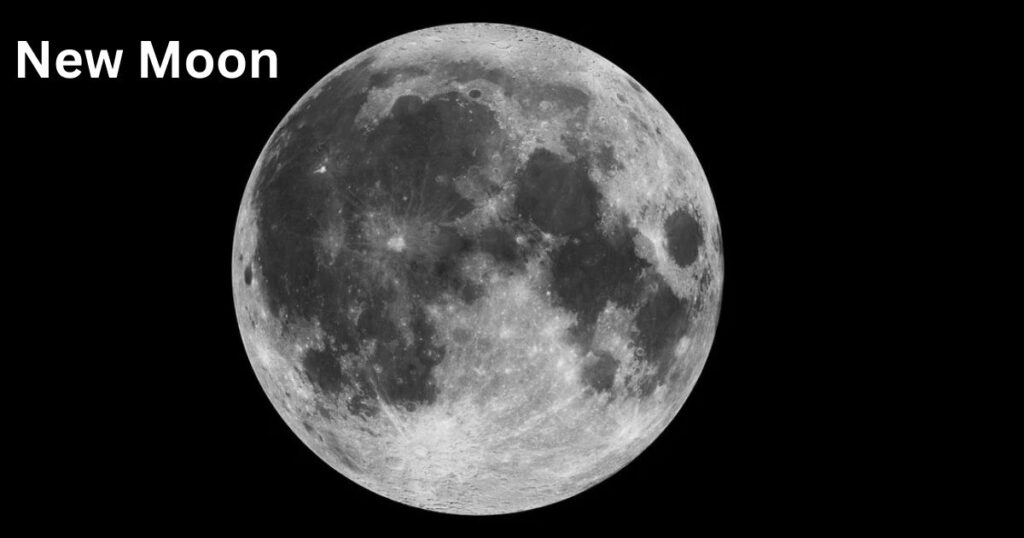
The new moon marks the exact moment when the Sun, Moon, and Earth align in syzygy — with the Moon positioned between Earth and the Sun. No reflected sunlight reaches us from the lunar surface; only the Moon’s dark, unilluminated hemisphere faces our direction.
Astronomers define this precise moment using right ascension — measuring the Moon’s position east of the vernal equinox along the celestial equator. The instant the Sun and Moon share identical right ascension is the technical new moon.
At this phase:
- The Moon rises and sets with the Sun
- Its illuminated face is hidden from view
- Dark skies make ideal conditions for stargazing, observing the Milky Way, meteor showers, and deep sky objects like nebulae and star clusters
- Eight distinct lunar phases follow before the cycle repeats
The Lunar Cycle & Moon Phases

The synodic month spans 29.5 days on average, though orbital eccentricity causes variation between 29.26 and 29.80 days. From new moon to new moon, eight distinct phases repeat in order:
Four Primary Phases:
- New Moon
- First Quarter (Half Moon, waxing)
- Full Moon
- Third Quarter / Last Quarter (Half Moon, waning)
Four Intermediate Phases:
- Waxing Crescent
- Waxing Gibbous
- Waning Gibbous
- Waning Crescent
Waxing = the illuminated portion is growing toward full. Waning = the illuminated portion is shrinking back toward the new.
Each of the eight phases — from Waxing Crescent through Waning Crescent — encodes a distinct emotional blueprint. Curious what your birth moon phase says about how you love and connect? Discover your profile on our Moon Phase Soulmate Calculator.
The lunisolar calendar interlocks lunar and solar cycles — 12 lunar months span roughly 354–355 days annually, creating a mismatch with the solar year that cultures resolve by inserting intercalary months.
These rhythms also shape nature: organisms from zooplankton to sea turtles synchronize reproduction and migration with moonlight. Agricultural traditions — from Mesoamerican farming to Vedic planting guides — reflect deep cross-cultural lunar observation.
New Moon & Solar Eclipses
Not every new moon triggers a solar eclipse. The geometry must cooperate precisely.
The Moon’s orbit is tilted approximately 5.1° from the ecliptic (the Sun’s apparent path through the sky), so perfect three-body alignment is rare. Eclipse windows occur only when a new moon coincides with the Moon passing through one of the two lunar nodes — the points where the Moon’s orbital plane intersects the ecliptic.
- At the ascending node (north node), the Moon crosses upward through the ecliptic
- At the descending node (south node), it crosses downward
- Eclipse seasons occur roughly every 173 days — twice per year
When alignment is achieved, the Moon’s umbra (full shadow) traces a narrow corridor of totality across Earth’s surface — typically less than 160 km wide. Outside this corridor, observers experience a partial eclipse or annular eclipse (if the Moon is near apogee and appears smaller than the Sun).
Most years bring two to five solar eclipses globally, but total solar eclipses visible from any fixed location occur only about once every 375 years on average.
New Moon & Tides
During a new moon, the gravitational forces of the Sun and Moon align along the same axis, amplifying their combined pull on Earth’s oceans. This produces spring tides — also called king tides — characterized by exceptionally high high-tides and very low low-tides.
Key facts about tidal behavior:
- Both new moon and full moon produce near-equal tidal intensity (spring tides), because both involve Sun-Moon-Earth alignment or opposition
- Neap tides occur at first and third quarter phases, when the Sun and Moon are at 90° (quadrature) to each other — gravitational forces partially cancel, reducing tidal range
- Tides follow a semidiurnal pattern in most locations (two highs and two lows per day) and are mathematically predictable using the tidal constituent model developed by Lord Kelvin
- The perigean spring tide (new or full moon coinciding with lunar perigee, when the Moon is closest to Earth) produces the most extreme tidal ranges of the year
Cultural & Religious Significance
Across human history, the new moon marked sacred beginnings and communal reset. The word “month” itself derives from “moon” in most Indo-European languages.
Major calendar systems anchored to the new moon:
- Islamic Hijri calendar — months begin with the first visible crescent after the new moon (the traditional hilal)
- Hebrew calendar — Rosh Chodesh (head of the month) marks the new moon with special prayers and observances
- Hindu calendar — Amavasya (new moon day) is observed as a time for ancestor veneration (pitru tarpan) and fasting
- Buddhist calendar — lunar phases determine Uposatha observance days
- Chinese lunisolar calendar — the new moon begins each month; the 1st and 15th (full moon) hold religious significance
Many indigenous traditions — from Native American lunar naming systems to Celtic moon-based planting cycles — treated the new moon as the most spiritually potent moment in the monthly cycle. Remarkably, independent cultures on separate continents arrived at synchronized lunar traditions, suggesting the new moon’s influence transcends any single civilization.
Lunation Numbers
Astronomers assign every new moon cycle a sequential lunation number — an unbroken cosmic record used to precisely identify any past or future lunar cycle. The current system traces back to a reference new moon, allowing researchers to calculate the exact phase of the Moon on any historical date.
Important nuances:
- The Moon’s orbit never repeats identically — orbital eccentricity causes the Moon to travel faster at perigee (closest approach, ~356,500 km) and slower at apogee (farthest point, ~406,700 km)
- The sidereal month (27.3 days) measures the Moon’s revolution relative to distant stars, while the synodic month (29.5 days) reflects its cycle as seen from Earth — the difference arises because Earth itself moves around the Sun
- Lunation numbers help connect these two reference frames for precise astronomical calculations
Our Wobbly Moon: Libration
Although the Moon is tidally locked — rotating once per orbit so the same face always points toward Earth — it doesn’t remain perfectly still from our perspective. It undergoes a rhythmic wobble called libration, revealing approximately 59% of the lunar surface over time (rather than just 50%).
Three types of libration:
- Libration in longitude — caused by orbital eccentricity; the Moon’s orbital speed varies, but rotation speed remains constant, creating an east-west wobble
- Libration in latitude — caused by the 6.68° tilt of the Moon’s equatorial plane relative to its orbital plane, creating a north-south wobble
- Diurnal libration — caused by Earth’s rotation, shifting an observer’s viewpoint by up to one Earth radius, adding a small daily parallax effect
The net result: a rhythmic ±7.9° sway in longitude and ±6.9° in latitude. Careful naked-eye observers can detect apparent shape shifts in the Moon across phases.
Moon Phases & Human Effects
The belief that lunar phases influence human behavior is embedded in tradition, physiology, and lived observation across cultures. Modern research has examined sleep patterns, menstrual cycles, psychiatric admissions, and crime statistics.
What science says:
- The Moon’s direct tidal force on the human body is negligible — roughly equivalent to the gravitational pull of a mosquito landing on your skin
- Studies on sleep patterns (notably a 2021 study in Science Advances) found modest correlations between lunar phase and sleep duration — individuals slept less and went to bed later in the days before a full moon, possibly linked to pre-industrial moonlight cues
- Research on menstruation suggests some synchrony in some individuals, though this remains debated
- The belief likely persists through illusory correlation — humans instinctively find patterns in coincidence — reinforced across generations as a meaningful tradition
In Hindu tradition, Amavasya (new moon day) is considered especially potent: a time for ancestor rites, introspection, and spiritual practice. Whether or not biological mechanisms support this, the psychological and cultural priming around lunar cycles is well-documented.
New Moon Dates 2026
Here are all the new moon dates for 2026 (UTC):
| Month | New Moon Date |
| January | Jan 29 |
| February | Feb 28 |
| March | Mar 29 |
| April | Apr 27 |
| May | May 27 |
| June | Jun 25 |
| July | Jul 24 |
| August | Aug 23 |
| September | Sep 21 |
| October | Oct 21 |
| November | Nov 20 |
| December | Dec 19 |
Frequently Asked Questions
What is the new moon?
The new moon marks the start of the lunar cycle — the moment when the Moon, positioned between Earth and the Sun, shows its unilluminated side to us, disappearing from the night sky.
Why can’t we see the new moon?
The Moon’s unlit hemisphere faces Earth during conjunction. Additionally, the Moon is positioned near the Sun in the sky, lost in solar glare during daylight hours.
How long is the lunar cycle?
Approximately 29.53 days (the synodic month), spanning eight distinct phases from new moon to new moon.
Can we ever see a new moon?
Yes — only during a solar eclipse, when the dark silhouette of the new moon passes in front of the Sun’s disk. Specialist equipment can sometimes detect an extremely thin crescent in bright blue sky at the precise moment of the new moon.
How does the new moon affect tides?
It produces spring tides (king tides) — the largest tidal range of the month — when the Sun and Moon’s gravitational forces combine along the same axis.
What is a Black Moon?
A Black Moon occurs when there are 13 new moons in a calendar year (two in one month), or the third new moon in a season with four new moons. The next Black Moon occurs on August 31, 2027.
What is the Dark Moon?
In traditional usage, the “Dark Moon” referred to the 1–3 days just before the new moon when the waning crescent disappears entirely — distinct from the new moon itself.
Does the new moon affect human behavior?
Hindu Amavasya traditions and some research studies suggest modest behavioral and sleep correlations with lunar phases. Scientific evidence remains inconclusive, but cultural and psychological significance is well-established.
What is the difference between a new moon and a solar eclipse?
Every solar eclipse happens at a new moon, but not every new moon produces a solar eclipse. A solar eclipse requires the new moon to also pass through a lunar node, aligning the Sun, Moon, and Earth precisely.