 Skip to content
Introduction
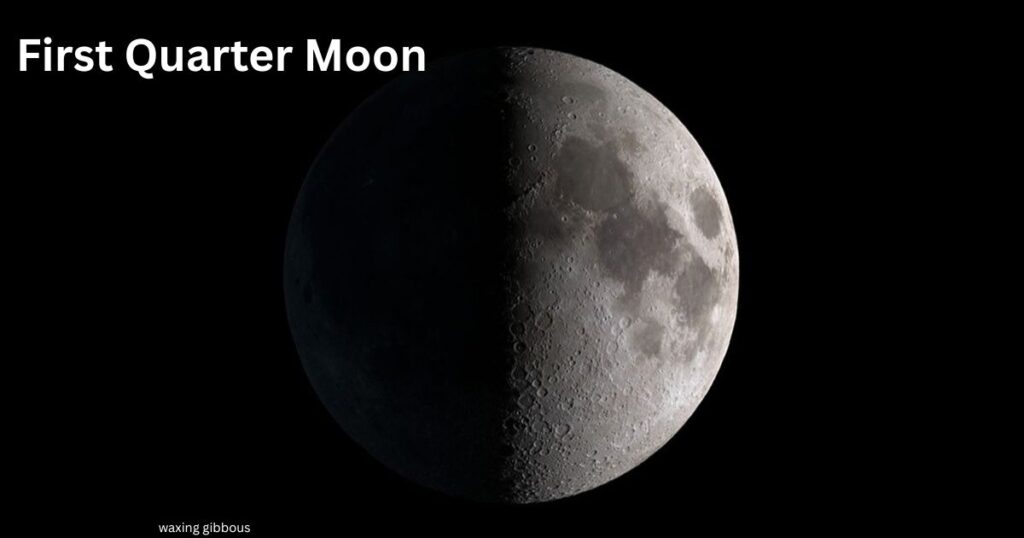
The first quarter moon marks a key phase in the lunar cycle, arriving halfway between the new moon and full moon. This second primary Moon phase reveals a striking half-illuminated disk rising at noon daily. Many observers mistake this Moon for a half moon, yet only one quarter of its total area has completed its orbit around Earth. The distinction reveals how position shapes our entire perception of the sky.
Reaching the first quarter point, the Moon sits at a precise angle to the sun, with exactly the right percentage of its surface catching direct light. The illuminated side appears crisp, vivid, and observationally rewarding. What makes this primary Moon phase fascinating is how the same celestial geometry plays out worldwide, regardless of location, time, or date. Whether viewed from top, bottom, left, or right, the sky delivers its consistent celestial promise. Curious how this phase connects to your personality or relationships? Try our Moon Phase Soulmate Calculator to discover your lunar match.
What Is the First Quarter Moon? / Definition
Most people glance at the half-illuminated Moon and assume it signals something unusual. In reality, this primary Moon phase occurs predictably, when exactly 50% of the Moon’s surface faces direct sunlight, splitting its visible face precisely.
Positioned halfway between the new moon and full moon, the quarter moon reaches its first quarter point during the lunar cycle. At this angle, the illuminated portion sits either left or right, depending on your location worldwide.
As a natural satellite traveling roughly 240,000 miles from Earth, the Moon takes one month to revolve through eight phases. The waxing moon stage confirms the illuminated side is actively increasing each passing day.
The terminator line divides the sunny and shadowed halves sharply, while the orbital plane keeps this geometry consistent. Whether seen from the day sky at noon or near midnight, it remains a defining primary moon spectacle.
When Does the First Quarter Moon Occur?
The first quarter moon arrives roughly seven days after the new moon, marking exactly one quarter of the orbit of Earth completed. This primary moon moment within the lunar cycle is trackable, predictable, and deeply consistent across every moon cycle.
What surprises many observers is how the waxing moon phase doesn’t feel like a third phase milestone — yet it absolutely is. The Moon’s surface catches the Sun’s rays at a perpendicular sun angle, making 50% of its face illuminated with striking clarity.
Historically, modern calendars assigned a symbol — a circle split with the right side white and the left side black — to represent this first quarter point. This official visual shorthand became a beloved term among astronomers and lunar enthusiasts worldwide for centuries.
The half-moon appearance during this quarter moment often misleads casual observers. Yet the geometry of Earth, the sun, and the half-moon confirms the increasing illumination characteristic of a true waxing moon reaching its precise halfway threshold.
How to See It — Naked Eye & Telescope Guide
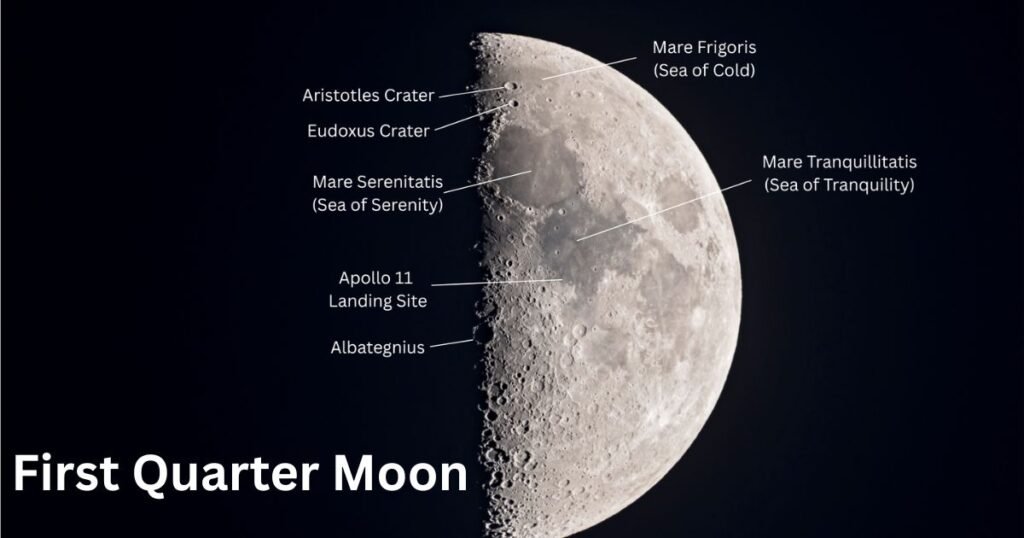
The first quarter moon is one of the most rewarding astronomical objects to observe daytime through the naked eye. It rises around noon, climbs highest in the sky near sunset, remaining visible long before stars appear overhead.
From personal experience, catching it in the blue sky during midday feels counterintuitive yet deeply satisfying. Unlike the Third Quarter Moon, which dominates the middle of the night, this phase peaks brilliantly through the middle of the day without any optical aid.
The Moon sets near midnight, giving observers a generous evening window. Positioning yourself opposite the Sun in the sky isn’t necessary here — the first quarter moon practically announces itself above the southwestern horizon every clear evening without effort.
Through a telescope, the terminator edge running across the Moon’s phase reveals dramatic shadow contrast. The lit up regions near the day side glow against deeply shadowed craters, making the bright moonrise hours ideal for studying lunar surface detail closely.
First Quarter Moon Photography Tips
Shooting the first quarter moon during direct sunlight hours surprises most photographers — the half-illuminated disk against a sunny sky produces razor-sharp contrast that nighttime shots rarely deliver. The terminator line becomes your most powerful compositional edge.
From experience, framing the Moon’s surface along the upper part and lower part of your shot creates dynamic tension. The whole moon rarely fits dramatically, so isolate the near half where light transitions from the lit-up side into deep dark side zones precisely.
The orbital plane angle determines whether the Northern Hemisphere or Southern Hemisphere perspective shows the moonset position lower or higher. Adjust your equator-relative shooting angle to keep the bright terminator oriented correctly within your frame every session.
Every day during the first quarter phase, surface shadow depth shifts measurably. The direct sunlight hitting craters along the terminator reveals textures invisible at full moon. Shooting from a dark location amplifies the Moon’s surface detail dramatically beyond urban conditions.
First Quarter Moon vs. Third Quarter Moon — Key Differences
Most observers assume the first quarter moon and third quarter moon look identical — they don’t. The half disk appears on opposite sides: right in the first quarter moon, left during the third quarter moon, confirming their mirror geometry.
The lunar cycle separates these two phases by roughly fifteen days. The first quarter moon follows the new moon on its way around Earth, while the third quarter moon appears after the full moon, beginning its descent back toward darkness and renewal.
What defines each phase isn’t just illumination — it’s the orbit position relative to Earth and the sun. The first quarter moon sits at a 90° angle ahead, the third quarter moon trails behind, meaning their rise and set timings differ by a full twelve hours.
Practically, the first quarter moon dominates evening skies while the third quarter moon rules pre-dawn hours. Understanding this half illumination timing helps astronomers, photographers, and planners schedule observations efficiently across every lunar cycle without confusion or overlap.
The Lunar Cycle / Moon Phases Overview
The lunar month runs precisely 29.5 days from new moon to next, cycling through eight Moon phases that western culture has tracked for millennia. Each phase reveals a distinct relationship between Earth, the Sun, and the Moon’s surface visibility from below.
What most practitioners overlook is how four primary moon phases and four intermediate phases divide the one-month cycle unequally in observational impact. The waxing crescent moon, waxing gibbous moon, waning gibbous moon, and waning crescent moon each carry unique surface characteristics worth studying independently.
The Moon sits closest to the same side alignment during new moon, then travels farthest apart by full moon. The sky darkens predictably as the shadowed portion grows, while half-illuminated, almost half-illuminated, and more than half-illuminated stages mark observable transitions across four primary phases.
The majority of the surface visible during the four intermediate phases shows crescent shape or gibbous geometry. From dark beginnings after new moon to next, the lunar month builds toward brilliance, then retreats — an orderly, perpetually repeating celestial sequence without deviation.
First Quarter Moon and Tides — Neap Tide Science
Few realize that the first quarter moon produces the ocean’s most modest tidal range. When Earth, Moon, and Sun form a near half-right angle, gravitational forces partially cancel, creating neap tides where 50% less tidal energy reaches coastal zones every day.
The alignment geometry during this phase is what separates neap tides from spring tides fundamentally. Unlike new moon or full moon configurations, where forces stack, the first quarter moon pulls perpendicular to solar gravity, making the Moon’s surface orientation critically relevant to tidal prediction models.
Coastal scientists track the lunar cycle carefully because neap tides arrive reliably halfway through each cycle. During the waxing crescent moon to first quarter moon transition, tidal amplitude drops measurably — something fishermen and harbor pilots across western culture have understood intuitively long before modern oceanography confirmed it.
The half-pie visibility of the first-quarter moon actually signals calm tidal windows. Visible from daylit side perspectives, this phase confirms gravitational offset is active. The north side tidal gauge readings during these windows consistently show the weakest surge patterns recorded.
First Quarter Moon and Human Sleep & Health — What Research Says
Research increasingly confirms what traditional Western culture observed across centuries — the moon subtly disrupts human sleep architecture. Studies tracking participants across a full lunar month found measurable reductions in deep sleep duration during the first quarter moon window specifically.
What surprises researchers is how sky brightness during the first quarter moon phase, even filtered through closed windows, suppresses melatonin production. The half-illuminated disk emits enough surface light to shift circadian rhythms, particularly affecting individuals sleeping in dark-sensitive environments without blackout conditions.
The majority of sleep studies conducted across one-month cycles show the first quarter moon correlates with later sleep onset times. Participants fell asleep roughly nineteen minutes later, mirroring how the waxing gibbous moon and waning gibbous moon phases each carry their own documented biological interference patterns.
From clinical observation, people tracking eight Moon phases report the waxing crescent moon through the first quarter moon transition as their most restless sleep window. The gravitational and luminosity shifts across four intermediate phases appear to create cumulative biological stress that new moon to next cycles gradually reset.
Gardening by the First Quarter Moon — What to Plant
Biodynamic gardeners have tracked the lunar month for centuries, understanding that the first quarter moon phase signals optimal above-ground planting conditions. During this window, sap movement intensifies, and seed germination rates measurably improve across four primary crop categories consistently.
The waxing crescent moon through the first quarter moon transition marks the precise moment soil moisture absorption peaks. Plants establishing roots during this crescent shape phase benefit from increased gravitational pull, drawing water upward through stems more efficiently than during any other half-illuminated lunar window afterward.
What experienced lunar gardeners rarely discuss is how the four intermediate phases affect different crop families differently. Leafy greens planted during the shift from waning crescent moon toward new moon to full moon show slower growth compared to those started during four primary moon phase windows, like the first quarter specifically.
The 29.5-day cycle gives gardeners roughly two optimal planting windows monthly. The farthest apart positioning of Sun and Moon during neap configurations, combined with the same side gravitational dynamics near closest approach, creates measurable soil energy shifts that seasoned lunar gardeners time their transplanting around carefully.
Spiritual and Astrological Meaning of the First Quarter Moon
If you’re exploring deeper lunar connections, you can calculate your compatibility using our moon phase soulmate tool based on your birth date. Astrologers rarely frame the first quarter moon as a moment of conflict — yet that’s precisely what it represents spiritually. This phase sits at the one-quarter point where intentions set at New Moon face their first real resistance, demanding conscious action rather than passive waiting.
The shadowed portion of the moon during this phase carries symbolic weight in lunar spiritual practice. What remains more than half illuminated in your awareness must now confront what stays dark — mirroring the waning crescent moon energy of release that practitioners deliberately integrate into monthly ritual cycles.
From personal practice, the lunar month rhythm becomes most psychologically demanding during four intermediate phase transitions. The shift from waxing gibbous moon energy back toward last quarter moon reflection creates a full emotional arc that the first quarter moon initiates — the first decisive push within every orderly lunar cycle.
Astrologically, Earth‘s relationship with the moon as it orbits through four intermediate phases generates distinct energetic signatures. The waning gibbous moon represents harvest, while the first quarter moon represents challenge — the half a pie moment where spiritual practitioners test whether their lunar month intentions hold genuine momentum.
Born Under a First Quarter Moon? — Personality Traits
People born under the first quarter moon carry an instinctive drive that mirrors this phase’s energy precisely. Like the illuminated half pushing against darkness, these individuals rarely retreat from challenge — they meet resistance head-on, often before others recognize a problem exists at all.
What astrologers and lunar psychologists consistently observe is how first-quarter moon personalities operate within an intermediate lunar cycle mindset. They excel at the first phase of any project, generating momentum from the waxing crescent moon foundation naturally, then pushing decisively through obstacles where others hesitate or stall completely. Want to see how your birth moon phase aligns with a partner? Use our moon phase compatibility calculator to find your ideal match.
The crescent shape of awareness that occurs before full illumination defines their psychological signature. These personalities see visible potential in incomplete situations, reading emerging patterns the way a practiced observer reads features across a partially lit lunar surface — intuitively, rapidly, and with remarkable forward-projected accuracy.
From birth chart analysis, those with first-quarter moon placements show dominant action orientation across all life domains. They illuminate paths rather than wait for full clarity, embodying the principle that decisive movement during partial knowledge consistently outperforms cautious hesitation under complete informational conditions.
Moon Phase Calendar Symbol
The symbol assigned to the First Quarter Moon in modern calendars is a circle split precisely down its vertical axis. The right side appears white, representing the illuminated face, while the left side remains black, indicating the portion turned away from direct sunlight completely.
What strikes me most professionally is how elegantly these primary Moon phase symbols communicate complex orbital geometry through pure minimalist design. A single bisected circle instantly tells any observer whether illumination is growing or retreating — information that once required direct sky observation nightly.
The Full Moon symbol uses a completely white circle, while the Third Quarter reverses the First Quarter Moon — showing the left side white and the right side black. This mirrors logic across primary Moon phase symbols, giving calendar users an immediate visual orientation within any lunar cycle at a glance.
| Phase | Symbol Design | Illuminated Side | Dark Side |
| First Quarter Moon | Half circle | Right side (white) | Left side (black) |
| Full Moon | Full circle | Both sides (white) | None |
| Third Quarter | Half circle | Left side (white) | Right side (black) |