 Skip to content
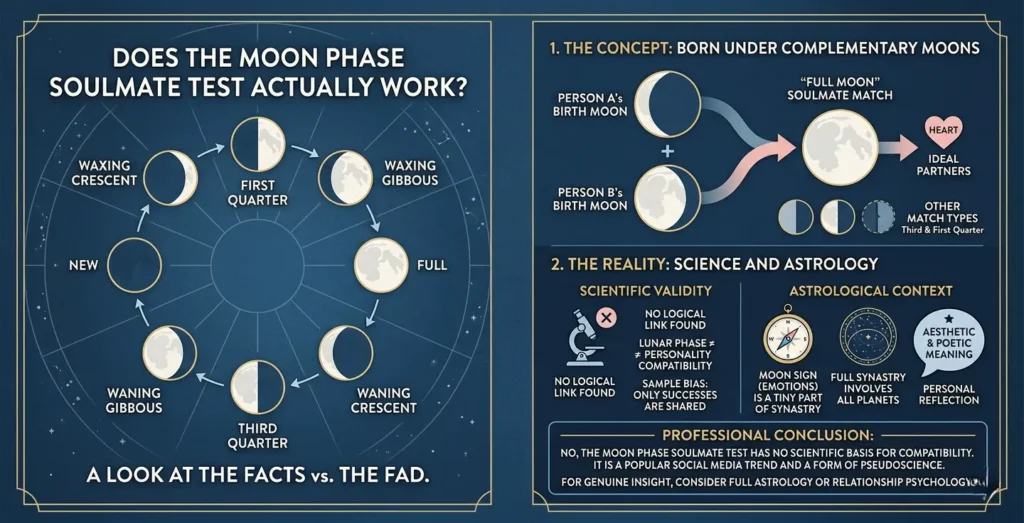
If you’ve spent any time on TikTok lately, you’ve almost certainly seen someone pressing two crescent moon images together, holding their breath to see if they form a perfect full circle. Welcome to one of the most viral astrology trends of the digital era — the Moon Phase Soulmate Test. But behind the beautiful lunar visuals and satisfying “click” of a complete moon, a real question lingers: Does any of this actually work? Let’s break it down honestly, combining astrological insight, psychological science, and a healthy dose of critical thinking.
Combined Introductions
Modern astrological enthusiasts often seek a celestial indicator to find their ultimate match. By analyzing the specific position of the moon during birth, seekers hope to determine if their moon phase yields true compatibility.
The full moon often signifies soulmates in this TikTok trend. Every natal chart holds secrets about your crush, lover, or even a bestie. Finding a twin flame starts with examining your unique birth moon.
Achieving 100% illumination creates a stunning lunar visual. This challenge requires visiting a moon phase site — such as Astro-Seek or MoonPage — to input your date and location of birth. Only then can you identify a potential soul mate.
Sharing a screenshot or image of your viral video is common. Using TikTok or a CapCut template, fans utilize a calculator like Astro-Seek to calculate if their partner is a 100% perfect full moon.
The mechanism behind this lunar phase compatibility is simple. With 8 billion people on Earth, grouping soulmates into eight lunar categories is a TikTok trend that is aesthetically pleasing — but rarely serves as a make-or-break factor in real relationships.
What Are Moon Phase Soulmates?
Finding a partner often involves modern TikTok trends where lunar data dictates romance. This soulmate concept suggests that our alignment with the universe depends entirely on the specific moon phase active during birth.
Celestial astronomy meets magical thinking as users seek psychological comfort through these cosmic connections. While skeptics argue there is no logical link between the moon’s illumination cycle and human romance, believers feel a full moon or birthday match indicates a destined path — even toward marriage.
The test gained viral status by promising a relationship anchored in something that feels like science, even if the trend relies mostly on beautiful imagery and video aesthetics. Every lunar cycle supposedly filters our compatibility into distinct energetic categories.
Experts often question the validity of such a mechanism, yet the image of two moon phases merging into one remains visually and emotionally compelling. This tool focuses primarily on astrologers’ interpretations of birth chart data rather than peer-reviewed physical science.
Ultimately, searching for a soul mate via TikTok helps individuals navigate the universe’s vastness. Whether a full moon appears or not, the lunar alignment offers a fun, low-stakes framework for any hopeful romantic — or anyone planning a wedding with a cosmic theme.
What Is The Moon Phase Compatibility Test?
Users flock to a moon phase site to calculate if their partner is a 100% perfect match. By entering a specific birth date, location, and birth time, the calculator determines your personal lunar image — the exact phase the moon occupied the moment you arrived on Earth.
This challenge involves using a TikTok template or CapCut to video the results. You take a screenshot from Astro-Seek to see if your combined moon shapes form a viral full moon visually — a complete, glowing circle that symbolizes unity and completion.
While the test feels exciting, the mechanism relies on third-party apps and websites like MoonPage and Moonphases.co. You simply calculate the lunar phase to see if the overlay creates a perfect, total circle representing spiritual alignment.
The moon phase compatibility trend suggests that 8 billion people fit into eight specific lunar categories. Using an Astro-Seek calculator, you find if your partner shares the make-or-break lunar phase required for a 100% spiritual connection, a twin flame reunion, or even a temporary psychic bond.
Despite skeptics pointing out a clear lack of scientific backing, the video trend persists — and even expands. Many people use CapCut to video their screenshots, proving that lunar compatibility remains a dominant viral challenge across social media platforms today.
How The Moon Soulmate Test Works
Testing alignment requires looking beyond a simple TikTok trend. Seekers often find psychological comfort when their birthday data matches a partner’s birth moon. This romance practice relies on finding a specific lunar shape that, combined with another person’s, forms a visual whole.
Many skeptics argue that science lacks a logical link here. However, for those planning a wedding or navigating new love, the universe seems to provide a magical thinking framework that is both accessible and emotionally satisfying. You simply compare each birth moon phase to check for visual compatibility.
The astronomy behind this involves calculating full moon proximity — how far each person’s birth moon is from complete illumination, and whether those two “missing pieces” complete each other. Users look for a full circular visual when their images are overlaid. It creates a tangible sense of cosmic destiny.
Lunar cycles offer a unique, visually engaging lens for exploring romance. By examining the moon at birth, couples seek a soulmate connection rooted in ancient lunar symbolism. This trend has dominated TikTok, brilliantly blending classical astronomy with modern digital dating culture.
Ultimately, the alignment is about the universe reflecting your partner choice back to you. Whether it is magical thinking or a genuine spiritual framework, the test provides psychological comfort and emotional validation. It remains a popular way to visualize deep compatibility — and to generate shareable content.
How To Find Your Moon Phase Soulmate
To begin, consider consulting professional astrologers to ensure your lunar phase reading is accurate and contextually valid. Do not just rely on a basic zodiac sign. A detailed natal chart reveals the specific moon position during your exact birth hour, which can differ significantly even within the same calendar day.
Here is a step-by-step process used by millions of TikTok users and astrology enthusiasts:
Step 1 — Find Your Birth Moon Phase.
Visit a reputable moon phase calculator such as Astro-Seek, Moonphases.co, or NASA’s moon phase archive. Enter your birth date, birth time, and location to identify the exact phase the moon was in when you were born.
Step 2 — Find Your Partner’s Birth Moon Phase.
Repeat the same process using your partner’s, friend’s, or crush’s birth information. Each person’s lunar birth phase is unique and represents their emotional energy signature.
Step 3 — Overlay the Two Images.
Using a TikTok filter, a CapCut template, or a compatible moon phase generator, place the two moon phase images side by side and slide them together. If they combine to form a complete full moon — a perfectly illuminated circle — you are considered soulmates by the test’s logic.
Step 4 — Interpret Your Results.
If both birth moons are identical, the trend labels you as a twin flame. Other combinations may suggest psychic connections, complementary energy, or growth-oriented bonds.
Modern leaders often use these insights to spark creative self-awareness. If you were born under a New Moon, you might be a go-getter seeking fresh beginnings and new achievements. Those born during the Waxing Crescent are often seen as alchemists with the drive to turn dreams into reality. First Quarter individuals are action-oriented manifestors, while those born under a Full Moon radiate intense emotional brilliance. Understanding your inner lunar world helps map out your unique path for personal and relational growth.
Does The Moon Phase Soulmate Test Actually Work?
Here is the honest, direct answer that most viral trend articles avoid giving you: No, not in any scientifically validated sense. But that doesn’t make it meaningless.
“The moon phase soulmate trend is old wine in new bottles. It plays into magical thinking and provides some psychological comfort. What is missing is any actual logical link between the phase of the moon and personality or relationship compatibility.” — Ben Radford, Deputy Editor, Skeptical Inquirer
Digital trends suggest your lunar birth alignment determines relational success. Practitioners observe how a Waxing Gibbous might express unique magnetic vibes. This match often feels significant when clicking through visual third-party apps — and that feeling is real, even if the celestial mechanism isn’t.
Seeking psychological comfort through MoonPage or Astro-Seek involves magical thinking — a cognitive pattern where unrelated events feel meaningfully connected. Some skeptics dismiss it entirely. However, many spiritually-oriented individuals find harmony and self-understanding by engaging the framework openly, releasing the need for empirical proof.
Does the New Moon provide rebellious, main-character energy? While scientific evidence remains thin, the emotional validity of these tools persists for millions of users. Many adventurous seekers prefer experiential meaning over laboratory logic — and there is nothing wrong with that, provided you keep perspective.
Last Quarter individuals might encounter conflicting self-assurance in this framework, yet the survivorship bias keeps the soulmate theory alive and spreading. Couples who match enthusiastically return to social media to celebrate; the vast majority for whom it didn’t work simply move on quietly. Astrologers do suggest that Waxing Crescent and Waning Gibbous alignments can foster passion and emotional balance in a lasting, vibrant partnership.
Establishing complementary chapters in a relationship requires far more than lunar illumination. While a Full Moon birth suggests expansive, radiant energy, logical evidence for romantic prediction remains scarce. Use moon phase websites to overlay your lunar data as a fun, reflective exercise — but remember that effort, communication, and emotional intelligence are what truly create harmony.
What Each Moon Phase Means For Your Personality
Analyzing your lunar identity requires moving beyond surface-level trends. Each of the eight primary moon phases — which repeat on the moon’s approximate 29.5-day cycle — is believed to imprint a distinct energetic quality on those born beneath it.
New Moon — If you were born under a New Moon, you carry a quiet, regenerative power. You are optimistic, trusting, and always excited by fresh starts. Your Waning Crescent spirit likely seeks renewal and prioritizes internal growth, dreams, and visionary thinking.
Waxing Crescent — Those born during a Waxing Crescent are often seen as alchemists and adventure seekers. They possess the drive to turn ambitious dreams into reality. This creative, hopeful energy defines big thinkers who inspire others through possibility.
First Quarter — First Quarter moon individuals are defined by action, resistance, and momentum. You do not shy away from conflict; you use it as fuel. This dynamic nature ensures you are always moving toward your goals, making you a natural problem-solver and change-maker.
Waxing Gibbous — This phase signifies a soul focused on refinement and self-improvement. You are naturally analytical, constantly tweaking your approach to life. This specific energy creates a personality that values progress, mastery, and helping others through hard times.
Full Moon — Those born under a Full Moon radiate a chaotic brilliance. This intensity defines your social presence. You crave visibility and emotional truth, often acting as a mirror for others’ hidden feelings. You are the life of the party — magnetic, expressive, and deeply emotional.
Waning Gibbous — Also called the Disseminating Moon, this phase produces natural connectors and teachers. You process experiences deeply and feel called to share your wisdom. Your personality thrives on meaning, gratitude, and authentic human connection.
Last Quarter — The Last Quarter moon births individuals in a permanent state of release and transition. You are introspective, philosophical, and willing to let go of what no longer serves. Old souls and quiet leaders often emerge from this phase.
Waning Crescent — Individuals with a Waning Crescent placement frequently feel a pull toward the mystical and the subconscious. Your personality thrives in introspection. You are the sage, processing ancient lessons to prepare your spirit for a brand new cycle.
The Science Of Why It Feels Real (The Barnum Effect)
The reason the Moon Phase Soulmate Test feels uncannily accurate has a name: the Barnum Effect (also called the Forer Effect). Named after showman P.T. Barnum and demonstrated by psychologist Bertram Forer in 1948, this well-documented cognitive bias explains why people accept vague, generalized personality descriptions as deeply personal and uniquely accurate.
Psychological influence shapes how individuals perceive celestial alignments during this viral challenge. While users search for cosmic validation, the brain naturally gravitates toward descriptions that feel intensely personal — even when those descriptions are broadly applicable to nearly everyone.
Your unique birth lunation seemingly mirrors deep personality traits, yet this resonance stems from cognitive biases rather than cosmic forces. We unconsciously ignore the descriptions that don’t fit while amplifying the ones that do, creating a fabricated sense of destiny that lacks any rigorous empirical foundation.
Subjective validation thrives when people seek external meaning for internal feelings. You might find your entire relationship reflected in the glowing lunar cycle description — but this is simply the mind organizing chaotic emotional reality into a satisfying narrative framework.
The allure lies in the comfort of predestination and pattern recognition. When a digital filter claims two souls align, the Barnum Effect ensures you identify with the result, regardless of the actual celestial physics involved. This is not a character flaw — it is a universal feature of human cognition.
Ultimately, these digital lunar divinations serve as entertainment and a catalyst for self-reflection rather than factual compatibility blueprints. The perceived accuracy is a testament to human imagination and our profound, timeless desire to find magic and meaning within the mundane data of our daily lives.
Moon Phases And Your Wedding Day
Choosing a wedding date involves aligning celestial rhythms to create an intentional, meaningful union. Many couples flourish when they honor the lunar cycle, syncing their vows with the specific moon phase present on their chosen day.
Selecting a wedding date around lunar timing requires examining how the moon influences emotional tides. The lunar positioning is believed by astrologers to influence the subconscious harmony of your ceremony, grounding your commitment within a larger, ancient cosmic framework that has guided human rituals for millennia.
Your wedding date acts as a permanent seal of your shared journey. By tracking the moon, you tap into a spiritual clock that has guided lovers, farmers, and navigators for centuries, ensuring your partnership begins with a sense of celestial awareness and intentionality.
When finalizing your wedding date, consider the moon as a silent, luminous witness. Its glow provides more than just ambiance; it offers a rhythmic blueprint for the emotional and spiritual landscape of your newly formed partnership.
Planning a wedding date around the moon is a sophisticated, deeply personal way to acknowledge the unseen energies that surround and support your relationship. This intentional lunar timing creates a unique atmospheric resonance, allowing your marriage to begin with a clear sense of cosmic purpose — and a stunning backdrop for photography.
FAQs
What Is A “Twin Flame” In This Test?
The concept of a twin flame implies a mirror soul — someone who reflects your internal energy back to you, often intensely and uncomfortably, during specific lunar alignments. This connection suggests that two individuals were once a single energetic entity, now seeking reunion through conscious, celestial tracking.
When analyzing birth charts, practitioners observe how lunar cycles dictate these intense spiritual bonds. Finding a twin flame requires more than visual moon phase matches; it demands deep alignment with your partner’s internal emotional rhythm and life path.
Psychologically, the test acts as a catalyst for deeper introspection. While some dismiss the Twin Flame concept as fantasy, the subconscious draws significant meaning from the lunar symbolism present during your initial earthly arrival. The moon becomes a personal mythological anchor.
Importantly, a twin flame bond is not always permanent or easy. It often serves as a turbulent teacher, pushing both individuals toward necessary growth, painful self-examination, and ultimately, deeper self-awareness. It is less about romantic bliss and more about transformation.
Whether the energy resonates depends entirely on your personal belief system. A twin flame remains a powerful spiritual archetype for those seeking cosmic validation of their most intense relationships, using the moon as a timeless, glowing witness to their inner journey.
Do I Need A Special App?
Navigating lunar compatibility does not mandate complex software, though enthusiasts often benefit from digital tools for precision. Understanding your natal birth moon can begin with simply observing the night sky, though apps significantly increase accuracy.
Digital platforms help track the Waning Crescent phase accurately, especially when pinpointing the exact moon phase at a specific birth time and location decades ago. Many seekers start with free online tools, then deepen their practice through natal chart readings with professional astrologers.
The most commonly recommended free tools include Astro-Seek, Moonphases.co, and NASA’s lunar archive, all of which allow you to input any historical birth date and receive an accurate moon phase result. TikTok’s built-in Moon Phase Test filter also eliminates the need for separate downloads by guiding you through the overlay process directly in the app.
Relying on your own direct observations of the current moon builds a raw, unfiltered lunar awareness over time. Most successful practitioners balance modern digital data with ancient wisdom — using apps for precision but intuition for interpretation.
Ultimately, soulmate discovery is an analog process in a digital world. Every phase offers a lesson that no algorithm can fully capture. Trust your instincts, your emotional intelligence, and your capacity for genuine communication as much as any lunar interface.
Which Phases Are Considered Soulmate Matches?
The trend categorizes romantic compatibility into several tiers based on how the two moon phases interact visually and energetically. Here is how the most commonly cited soulmate pairings break down:
A Full Moon and New Moon pairing creates a profound equilibrium — intense illumination balancing quiet, internal reflection. This complementary dynamic fosters deep spiritual growth and emotional counterbalance, making it one of the most cited soulmate pairings.
A Waxing Gibbous paired with a Waning Gibbous thrives on the shared momentum of expansion and release, bridging the gap between manifesting desires and expressing profound gratitude. This pairing resonates with couples who support each other’s self-improvement journeys.
First Quarter individuals find surprising synergy with those born under the Last Quarter. This dynamic tension mirrors the friction necessary for evolution, proving that the best matches aren’t always easy but are undeniably transformative.
A Waxing Crescent offers fresh, hopeful perspectives that perfectly ground the introspective nature of a Waning Crescent. Together, they form a complete cycle — the eternal dance between beginning new journeys and concluding ancient karmic ones.
Those born under the same moon phase are labeled twin flames within this framework — sharing similar emotional energy, life instincts, and core values. However, professional astrologers note that same-phase compatibility is energetically intense but not inherently harmonious in the romantic sense.
While enthusiasts seek perfect matches, the specific geometry between lunar positions dictates the underlying energetic frequency. Any phase can harmonize beautifully when the individuals involved cultivate emotional intelligence, honest communication, and mutual respect — the true foundations of lasting love.
Is There Any Scientific Backing?
This is the question every honest article on this topic must address directly: No, there is no credible scientific evidence supporting the moon phase soulmate test as a reliable predictor of romantic compatibility.
While modern enthusiasts claim lunar cycles predict human connections, scientific rigor remains entirely absent from this domain. Searching for peer-reviewed evidence reveals a consistent disconnect between celestial illumination patterns and the complex, lived reality of a thriving long-term relationship.
Gravity from the moon affects ocean tides — that is settled, observable physics. However, illumination levels at the moment of birth do not statistically correlate with personality traits, emotional patterns, or any measurable dimension of interpersonal compatibility. No mechanism for such influence has ever been proposed, let alone tested.
As Ben Radford of the Skeptical Inquirer notes, this trend has “all the hallmarks of a typical TikTok trend” — it makes a game out of something personal (your birthday) and delivers satisfying, aesthetically pleasing results, but provides no logical bridge between the moon’s phase and who you should love.
We must distinguish clearly between poetic lunar symbolism — which has genuine cultural, psychological, and creative value — and empirical predictive science. Using a moon phase to identify a soulmate is a charming, meaningful ritual for those drawn to astrology. But no peer-reviewed study provides evidence that it influences human behavior in any measurable way.
The honest conclusion? The backing for this test is purely cultural and psychological — and that is okay. Genuine relationship health depends on communication, shared values, emotional safety, and consistent effort. The moon phase test can be a beautiful, reflective starting point. It should never be the deciding factor.
The Bottom Line: Should You Try It?
Yes — with the right expectations. The Moon Phase Soulmate Test is not a scientific compatibility instrument, but it is a genuinely engaging tool for self-reflection, conversation, and cosmic curiosity. It invites you to consider your emotional energy, your relational patterns, and what you are truly seeking in a partner.
If you and your partner overlay your birth moons and they form a perfect full circle, celebrate it — not as proof of destiny, but as a beautiful symbol of your intention to grow together. And if they don’t align? Remember the words of astrologer and PureWow contributor Evan Nathaniel Grim: the test is ultimately “better for showing off your love online than predicting whether you’ve found the one.”
For deeper astrological compatibility insights, explore your Venus sign (ruling romance and attraction), your seventh house (governing long-term partnership), and your Mars, Mercury, and Juno placements. These offer a far richer, more nuanced picture of relational chemistry than any single lunar data point.
The moon has guided human hearts for thousands of years. Whether through tide charts or TikTok filters, its pull on our imagination is undeniable. Use it wisely, use it joyfully — and always trust the work of genuine connection over the glow of any screen.