 Skip to content
Introduction
I trust the Waning Crescent Moon phase most when certainty feels overrated: its lit-up part narrows, yet attention sharpens. From my telescope notes, the Moon’s face between 50% and 0% illumination teaches restraint before renewal quietly. Rather than treating the crescent as a weakness, I read its curved sickle shape as skilled editing. The Moon’s surface still receives the Sun’s rays, but only a small part stays directly illuminated for practical skywatchers tonight.
In practice, it rises after midnight, slips into the morning schedule, hangs in the day sky, then sets in the afternoon. Before sunrise, I check the east for the thinning lighted portion before breakfast truly begins. Historically, observers tied this last phase to release, rest, surrender, and return to yourself — not gloomy endings. Its faint glow, or earthshine, reminds me that life unfolds in phases whenever judgment becomes too rigid for growth again. This phase follows the Last Quarter Moon (also called Third Quarter) and ends when the New Moon begins a fresh synodic month of approximately 29.5 days.
What Is the Waning Crescent Moon? Definition and Phase Explained
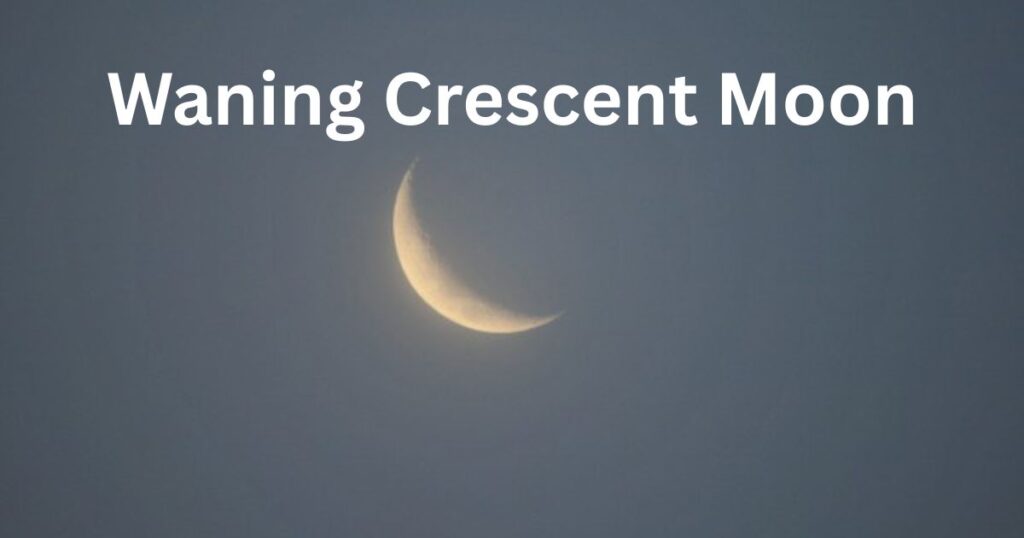
The Waning Crescent is the eighth and final Moon phase in the lunar cycle. It begins just after the Third Quarter Moon — when the Moon’s illumination drops below 50% — and continues shrinking until it reaches 0% at New Moon. During this phase, the illuminated portion appears as a thin curved arc, visible on the left side in the Northern Hemisphere and the right side in the Southern Hemisphere.
The word waning means the lit area is getting smaller each day. The word crescent refers to the signature curved, sickle-like shape. Together, they describe the Moon’s final visible stage before it disappears into the dark Moon period preceding New Moon.
Key facts at a glance:
- Illumination range: ~49% down to 0%
- Moon age: approximately 22–29 days into the lunar cycle
- Rises: after midnight (typically 2–4 AM)
- Best viewing time: predawn eastern sky, before civil dawn
- Sets: afternoon
- Visible in: morning sky, sometimes daytime sky
- Follows: Last Quarter Moon
- Precedes: New Moon
A Waning Moon Shrinks — The Waning Crescent Phase in Detail
By the time the Waning Crescent Moon reaches my kitchen window, the story is already thinning: lighted portion withdrawn, illuminated side narrow, sickle shape quiet, yet its daily motion still teaches discipline before coffee softly. People expect the last phase to feel empty, but after years of watching the morning Moon near dawn glare, I read it as compression, not absence — a practical invitation to turn inward with calm care.
Astrologically, I avoid romantic fog here; spirituality, deep rest, and imagination matter only when grounded in timing, because the old Moon rises east, before sunrise, letting practice meet ordinary fatigue without drama or performance today. For a Waning Crescent Moon child, this phase is less prediction than craft: see in the dark, respect shadow, trust natural timing, and let greater messages become behavior — not décor — through quiet daily practice tonight.
The terminator — the line dividing the Moon’s lit and unlit portions — moves progressively toward the limb during this phase, revealing lunar craters and mountain ranges in sharp relief due to extended shadows. This makes the Waning Crescent an excellent period for lunar observation with binoculars or a telescope, as surface features near the terminator stand out with high contrast.
The Lunar Month: A Repeating 29.5-Day Cycle
I usually read the lunar month backward: the last phase of the cycle explains why each Moon phase feels like practice, not spectacle. After the Third Quarter Moon, attention loosens, and the waning rhythm teaches restraint. At my telescope, the lit side seems less important than the surrounding hush; dawn begins, sunrise follows, and the backdrop stars fade while the day side quietly returns practical proportion to observation for patient watchers.
Some students expect the New Moon to erase everything, yet the nearly dark arc still holds instruction. Its light is spare, almost psychological, helping an old soul notice what hurried measurements overlook during each return. When teaching phases, I avoid tidy ladders; the intermediate Moon phase asks for lived timing. A visionary may treat the repeating pattern as an innate gift — a vehicle for knowledge, not a prediction ritual alone.
The complete lunar cycle — also called a lunation or synodic month — lasts precisely 29 days, 12 hours, 44 minutes, and 3 seconds. The eight recognized Moon phases are: New Moon → Waxing Crescent → First Quarter → Waxing Gibbous → Full Moon → Waning Gibbous → Last Quarter → Waning Crescent. The four primary phases (New, First Quarter, Full, Last Quarter) occur at specific moments worldwide. The four secondary or intermediate phases — including the Waning Crescent — represent spans of time rather than single instants.
Earthshine: Reflected Sunlight on the Dark Moon
Working backward from the end of the night, I judge Earthshine by absence: the rest of the Moon stays faintly visible because Earth reflects sunlight toward the Moon, even when the thin sliver dominates quietly overhead. During predawn sessions, I stop treating the Sun as missing; its geometry is present through the Da Vinci glow, most noticeable in April and May, when humid horizons soften the darkness without stealing definition yet.
Contrary to classroom sketches, Earthshine is not decoration; it tests whether the visible surface can remain emotionally convincing while barely illuminated — a practical lesson for observers tracking predawn crescent appearances before civil dawn begins properly. I have seen beginners search for brightness first, but the better method is patience: let light leak across atmospheric haze, compare the orientation, then decide whether the crescent’s quiet disk is honestly revealed or imagined.
What causes Earthshine?
When the Sun illuminates Earth’s oceans, clouds, and landmasses, roughly 30% of that light reflects back toward the Moon. This faint reflected light falls on the Moon’s dark side — the portion not directly lit by the Sun — giving it a ghostly pale glow visible to the naked eye during thin crescent phases. Leonardo da Vinci correctly described this mechanism around 1510, which is why it carries his name as the Da Vinci glow.
How to Spot Venus Near the Waning Crescent Moon

Before dawn, I first check the date, then the location; a thin waning crescent can make Venus seem nearer than expected, though the Moon’s position and the planets simply share one morning sky for careful observers. I learned to ignore social-media exaggeration: Venus is not chasing the Moon. The line, curve, and terminator show lunar shape; meanwhile, eastward motion and percentage explain why closeness changes quickly overnight for backyard watchers nightly.
When the pair sits high in the sky, I compare the crescent’s right side, left, top, and bottom from both Northern Hemisphere charts and Southern Hemisphere notes, because orientation can fool seasoned eyes at twilight. Use binoculars only after confirming the Sun is hidden; then record 5% illuminated, 13% waning crescent moon, or 2% illuminated waning crescent beside Venus — building a Moon phase pages habit that improves memory and timing.
Why does Venus appear near the Waning Crescent so often?
Venus, the third brightest object in the sky after the Sun and the Moon, orbits the Sun on roughly the same plane as Earth and the Moon — the ecliptic. Because all planets travel along this imaginary line, Venus, Mercury, Mars, Jupiter, and Saturn regularly appear close to the Moon in the predawn or evening sky. During the Waning Crescent phase, Venus is seen as the morning star, rising ahead of the Sun in the eastern sky. Their apparent proximity creates striking conjunctions that make excellent targets for photography.
Why the Waning Crescent Looks Different Around the Globe
From my latitude, the Waning Moon never feels identical twice; its illuminated part tilts differently because Earth is round, the sky is local, and the ecliptic cuts each horizon at changing angles before quiet dawn. Travel south, and a Crescent Moon that seemed like a bowl may stand upright; travel east, and mornings alter its height, while Venus, Mercury, and other planets appear to meet in the sky nearby briefly.
I learned this photographing from Canada and reading reports from Taipei, Taiwan; Tripoli, Libya; and San Antonio, Texas: the same lunar cycles carry shared symbolism, yet local air reshapes color, sharpness, and scale at sunrise. That is why calendars flatten the view with symbols, but practice says nothing stays fixed; everything moves through tides, seasons, atmosphere, and perspective — making knowing your Moon phase a grounded, place-based skill for observers everywhere.
Northern Hemisphere vs. Southern Hemisphere orientation:
In the Northern Hemisphere, the Waning Crescent’s illuminated arc appears on the left (eastern) side. In the Southern Hemisphere, the same phase shows illumination on the right (western) side. Along the equator, the crescent may appear nearly horizontal — like a “boat Moon” or “smile Moon” — because the ecliptic runs steeply overhead rather than at a shallow angle. This orientation difference does not change the phase’s timing or illumination percentage — only its apparent tilt relative to the horizon.
Why There Is No Waning Crescent Symbol in Most Calendars
Calendars often flatten Moon phases into icons, so the Waning Crescent Moon gets hidden between the Last Quarter Moon phase and the New Moon phase — though in practice, its shrinking edge changes my dawn planning quietly, daily. When clients expect eight Moon phases, I show why printed grids prefer four primary phases; the four intermediate phases lose space, and the crescent becomes an invisible New Moon problem, not an astronomy error today.
My old nautical almanac marked the Third Quarter, then silence, yet the lunar month still moved 29.5 days; observation — not boxes — taught the crescent fades, disappears, and will reemerge before sunrise for patient watchers nearby. So I read calendars contrarily: absence names the same cycle indirectly. The missing sliver still carries energetic qualities, completion of the cycle, and the affirmation — I see in the dark; I know the light — within practice.
The Islamic (Hijri) calendar and many lunisolar calendars depend on the crescent’s first visibility to mark the start of each month — meaning the Waning Crescent’s disappearance and the Waxing Crescent’s first sighting are culturally and astronomically significant moments across many traditions worldwide.
Community Photos of the Waning Crescent Moon (EarthSky Gallery)
EarthSky contributors often surprise me: a faint arc near dawn becomes more persuasive than any Moon illustration. Their frames show sunlight thinning, the bright side leaning over dark parts, with Earth quietly present in each careful exposure. When viewers post from all over the world, the crescent refuses one standard appearance. Latitude, haze, lens choice, and local horizon change the area lit up — so the same Moon teaches patience before naming direction in morning notes accurately.
I check the gallery for Venus because the morning star — the third brightest object — often sharpens scale. Its orbit near the imaginary plane makes a practical marker, not decoration, beside delicate lunar horns in predawn community submissions from observers. Those photos remind me that the cycle is not abstract: after the Last Quarter Moon, the curve grows smaller each day. In practice, this fading phase carries beginnings, intuitive timing, and a gentle anchor for photographers planning fieldwork before sunrise.
Photography tips for the Waning Crescent Moon:
- Shoot 30–45 minutes before civil dawn when the crescent is still visible, but the sky has some color
- Use a tripod and shoot in RAW for maximum detail recovery in low light
- Include foreground elements — trees, architecture, water — to convey scale
- Exposure bracket to capture both the earthshine and the crescent arc without overexposing
- In April–May, include the Da Vinci glow (earthshine) for dramatic effect
Born Under a Waning Crescent Moon? Your Personality and Energy Profile
If your birth arrived under the Waning Crescent, I read your energetic signature as quietly precise: you notice endings before others do, protect your subtle waters, and sense when process change needs privacy first most. Contrary to popular readings, this placement is not a weakness; ancient traditions trusted waning children with collective decision-making, rites of passage, and quiet timing — because many cultures valued release as skilled practice, not mystical drama alone.
I’ve seen these natives track mood like the Moon orbits Earth: changes phase in an orderly way, moving through eight distinct phases without rushing initiation, because their courage matures near silence before the New Moon. My advice is practical: keep ceremonies small, honor every season of life, and remember you are already whole. Your private illumination often appears after the world stops asking for proof or performance at all tonight.
Key personality traits of Waning Crescent Moon children:
- Deeply intuitive — often described as psychic or having strong gut instincts
- Old soul energy — a sense of wisdom that arrives early in life
- Natural visionary — gifted with imagination, spiritual insight, and long-range thinking
- Introspective — needs solitude and quiet time to recharge and process
- Completion-oriented — understands endings, release, and closure intuitively
- Private courage — strength that builds in silence, away from public validation
People born under this phase are sometimes said to carry the accumulated wisdom of the entire lunar cycle — as if every previous phase left a mark on their emotional and spiritual makeup before they arrived.
Waning Crescent Moon Spiritual Meaning and Rituals
The Waning Crescent holds powerful spiritual symbolism across many traditions. It represents surrender, release, introspection, and the conscious act of letting go of habits, patterns, relationships, or beliefs that no longer serve growth.
Spiritual themes of the Waning Crescent:
- Release and surrender — clearing emotional weight carried since the Full Moon
- Banishing and cleansing — traditionally a time for removing negativity, breaking old patterns
- Rest and restoration — honoring the body and spirit before the next cycle begins
- Shadow work — examining parts of the self usually kept hidden
- Gratitude and closure — acknowledging what the cycle produced before releasing it
Waning Crescent rituals practitioners use:
- Journaling prompts: What am I ready to release? What have I outgrown this cycle?
- Cleansing baths with calming herbs such as lavender or rosemary
- Meditation focused on breath, surrender, and stillness
- Crystal work — amethyst for rest and spiritual renewal; black onyx for protection during release
- Decluttering physical spaces to mirror internal clearing
- Candle rituals — burning written intentions or fears to symbolize release
Many practitioners also observe the dark Moon — the 1–3 day period between the last visible Waning Crescent and the New Moon — as a distinct time for complete stillness and deep inner retreat before the cycle renews.
Waning Crescent Moon Jewelry and Symbolic Meaning
When I choose jewelry for the Waning Crescent, I avoid loud Full Moon pieces; this time favors a quiet symbol — slim arcs, matte silver, and stones that feel private against the skin after midnight rituals. A pendant shaped like a semicircle or softened half teaches restraint better than oversized moons. In studio consultations, taste varies; some clients want black onyx, others pearl — especially during evenings under the night sky alone.
I often pair zodiac engravings with ancient timing: pieces chosen near New Moon thresholds support release before you initiate plans, letting intention grow subtly rather than demanding instant sparkle or public approval from anyone else. For collectors who track planting cycles, a Waning Crescent ring can mark closure, not lack. I set tiny stones on the opposite half, leaving open metal to honor silence, recovery, and disciplined momentum each month.
Common Waning Crescent jewelry symbolism:
- The thin curved arc represents letting go gracefully
- Silver metal corresponds to lunar energy and intuition
- Open crescent designs honor the dark, unlit portion — the shadow self
- Stones: black tourmaline, obsidian, moonstone, labradorite, amethyst
What Does Your Moon Phase Mean? — Waning Crescent in Birth Charts
In practice, a Waning Crescent reading begins after the lunar story has already peaked: the entire face was lit up, then intention shrinks, inviting quieter edits rather than dramatic manifestations or public declarations now during release. I learned through clients who track Western culture calendars that meaning gets flattened by four primary phases: the soul notices subtler hinges between First Quarter, Third Quarter, and the exhausted glow after fullness at night.
Contrary to beginner lore, this phase is not failure after Waxing Gibbous Moon ambition; it is discernment — a private audit where Waning Gibbous Moon lessons repeat until patterns loosen from habit without forcing certainty again. When someone pairs meditation with an I Am Whole affirmation or watches Venus as the evening star, I ask what is being released, not gained; Waning Crescent wisdom is completion before renewal inside ordinary practice.
How to find your Moon phase: To determine which Moon phase you were born under, enter your date, time, and location of birth into a Moon phase calculator or astrology birth chart generator. The Moon moves through the entire zodiac in approximately 27.3 days (the sidereal month), visiting a new zodiac sign roughly every 2.5 days — so birth time matters significantly for accuracy.
FAQs
What does the Waning Crescent Moon mean spiritually?
Spiritually, the Waning Crescent represents release, surrender, and rest. It is a time to let go of what no longer serves you — old habits, negative thought patterns, and emotional weight — before the New Moon begins a fresh cycle.
When is the best time to see the Waning Crescent Moon?
The best time is in the predawn eastern sky, roughly 30–60 minutes before sunrise. As the phase progresses toward New Moon, the crescent becomes thinner and harder to spot even in ideal conditions.
How long does the Waning Crescent phase last?
Approximately 6–7 days, from just after the Third Quarter Moon until the New Moon.
What percentage illuminated is the Waning Crescent?
It spans from roughly 49% down to 0% illumination — the final stretch of the waning lunar cycle.
Is the Waning Crescent a good time to start new projects?
Most traditions recommend waiting for the New Moon or Waxing Crescent to begin new endeavors. The Waning Crescent is better suited for completing, releasing, resting, and reflecting rather than initiating.
What is the difference between Waning Crescent and Waxing Crescent?
Both are crescent-shaped, but they appear at opposite ends of the lunar cycle. The Waxing Crescent follows the New Moon and is growing brighter (visible in the evening western sky). The Waning Crescent precedes the New Moon and is getting dimmer (visible in the morning eastern sky).