 Skip to content
Last Updated: April 15, 2026 | Category: Moon Soulmate Guides
Quick Answer: When Is the Next Full Moon?
The next full moon is the Flower Moon on Friday, May 1, 2026, at 1:23 PM EDT (17:23 UTC). It shines in the constellation Libra and is classified as a Micromoon — occurring near the Moon’s apogee (farthest point from Earth). May 2026 is rare: it hosts two full moons, with a Blue Moon following on May 31 at 4:45 AM EDT.
Full Moon Calendar 2026: Complete Dates, Times & Names
| # | Date | Time (EDT/EST) | Traditional Name | Special Type |
| 1 | January 3 | 5:03 AM | Wolf Moon | Supermoon |
| 2 | February 1 | 5:09 PM | Snow Moon | — |
| 3 | March 3 | 6:38 AM | Worm Moon | Total Lunar Eclipse / Blood Moon |
| 4 | April 2 | 10:12 PM | Pink Moon | — |
| 5 | May 1 | 1:23 PM | Flower Moon | Micromoon |
| 6 | May 31 | 4:45 AM | Blue Moon | Micromoon |
| 7 | June 29 | 7:57 PM | Strawberry Moon | Micromoon |
| 8 | July 29 | 10:36 AM | Buck Moon | — |
| 9 | August 28 | 12:19 AM | Sturgeon Moon | Partial Lunar Eclipse |
| 10 | September 26 | 12:49 PM | Harvest Moon | — |
| 11 | October 26 | 12:12 AM | Hunter’s Moon | — |
| 12 | November 24 | 9:53 AM | Beaver Moon | Supermoon |
| 13 | December 23 | 6:14 PM | Cold Moon | Supermoon |
All times are U.S. Eastern Time. The Moon appears visually full for approximately 1–3 nights surrounding each listed date. 2026 has 13 full moons — one extra due to May’s two full moons.
What Is a Full Moon?
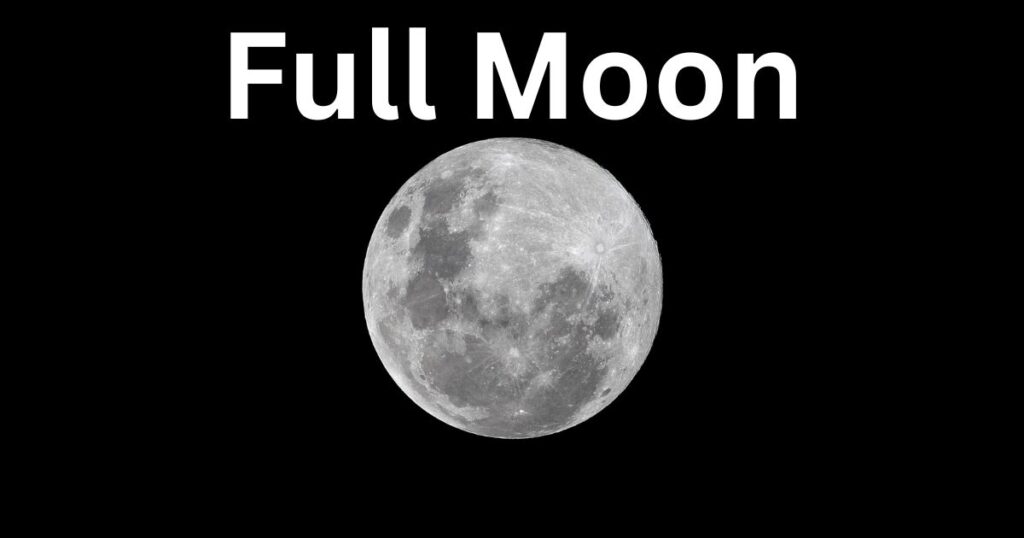
A full moon occurs when the Moon, Earth, and Sun reach an ecliptic longitude separation of 180 degrees — a geometric alignment astronomers call syzygy. The entire near side of the Moon faces Earth, bathed in direct sunlight, producing the circular, luminous disk visible in the night sky.
Two important clarifications:
The moment of total fullness is instantaneous. The Moon’s phase shifts continuously throughout its orbit. What appears “full” to the naked eye spans roughly 1–3 days, when the Moon reaches approximately 98–100% illumination.
The Moon produces no light of its own. It reflects sunlight off its surface — the same side always facing Earth due to tidal locking, a phenomenon called synchronous rotation.
How the Full Moon Differs From Other Phases
The full moon is the emotional and energetic peak of the 29.5-day lunar cycle. Unlike the outward-building energy of the waxing phases or the reflective pull of waning phases, the full moon represents a moment of culmination — heightened visibility, intensity, and revelation. For this reason, it carries enormous significance in spiritual traditions, astrology, and the study of lunar compatibility.
If you’re exploring how lunar phases shape your emotional nature and relationships, our Moon Phase Soulmate Calculator identifies which phase was active at your birth and what that means for how you connect with others.
The 8 Lunar Phases and Their Sequence
The Moon passes through eight distinct phases during each synodic cycle. These are not abrupt switches but continuous gradations driven entirely by orbital geometry — the changing angle between Moon, Earth, and Sun.
Waxing (growing) phases:
- New Moon — The illuminated side faces away; the Moon appears invisible from Earth.
- Waxing Crescent — A thin, growing sliver emerges after sunset.
- First Quarter — The right half is illuminated; the Moon rises around noon and sets around midnight.
- Waxing Gibbous — More than half is lit; brightness increases nightly toward the peak.
Peak: 5. Full Moon — The complete near side is illuminated; rises near sunset, sets near sunrise.
Waning (diminishing) phases: 6. Waning Gibbous — Illumination begins decreasing; the Moon rises progressively later each evening. 7. Last Quarter — The left half remains lit; the Moon rises near midnight. 8. Waning Crescent — A shrinking sliver visible before dawn; the cycle prepares to reset.
Each transition flows without a hard boundary. The full cycle — new moon back to new moon — spans one synodic month, averaging 29 days, 12 hours, and 44 minutes.
Tip: Wondering which of these eight phases you were born under? Use our Moon Phase Soulmate Calculator to discover your birth moon phase and what it reveals about your emotional blueprint and relationship style.
How Long Between Two Full Moons?
The interval between consecutive full moons averages exactly 29.5 days (more precisely: 29 days, 12 hours, 44 minutes, 2.9 seconds). Because most calendar months contain 30 or 31 days, the full moon drifts slightly later each month — which is why some months contain two full moons, producing a Blue Moon.
The Moon’s elliptical orbit also creates natural timing variation of up to 13 hours between cycles. This is why full moon times must be calculated from precise astronomical tables rather than assumed from averages.
In 2026, this drift produces 13 total full moons — the extra one falling on May 31.
Full Moon Names: Origins and Meanings for 2026
Each full moon name originated from Native American, Colonial American, and European traditions — practical ecological calendars encoding seasonal knowledge. They were functional timekeeping tools, not poetic inventions. Here is the complete 2026 breakdown:
Wolf Moon — January 3 (Supermoon) Named for the howling of wolves during deep winter. Also called the Moon After Yule in European tradition. In 2026, this is the year’s first Supermoon, appearing larger and brighter than average.
Snow Moon — February 1 marks the heaviest snowfall month across North America. Sometimes called the Hunger Moon, reflecting scarce resources for both people and wildlife.
🪱 Worm Moon — March 3 (Total Lunar Eclipse / Blood Moon) Named for earthworms emerging as frozen ground thaws. The most dramatic astronomical event of 2026 — this full moon coincides with a Total Lunar Eclipse, turning the Moon deep red or copper during totality.
Pink Moon — April 2 Named after wild ground phlox (Phlox subulata), one of the earliest widespread spring wildflowers in North America. Despite its name, the Moon will not appear pink.
Flower Moon — May 1 (Micromoon) Named for the abundance of spring blossoms across the continent. As a Micromoon — occurring near the Moon’s farthest point from Earth — it appears slightly smaller than average. The first of two full moons in May 2026.
Blue Moon — May 31 (Micromoon) The second full moon in a single calendar month. Blue Moons occur roughly every 2.5–3 years. The Moon will not appear blue — this is a calendrical distinction, not a visual one, though atmospheric conditions like wildfire smoke can occasionally shift the Moon’s color.
Strawberry Moon — June 29 (Micromoon) Named for the peak of wild strawberry harvesting season. Known in European traditions as the Rose Moon or Mead Moon. Also, a Micromoon in 2026.
Buck Moon — July 29 Named for the period when male deer begin growing new antlers. Also called the Thunder Moon for the frequency of summer storms in this season.
Sturgeon Moon — August 28 (Partial Lunar Eclipse) Named by Great Lakes and Lake Champlain tribes for the large sturgeon fish most readily caught in late summer. In 2026, this moon coincides with a Partial Lunar Eclipse, creating a dramatic shadow across the lunar disk.
Harvest Moon — September 26: The full moon closest to the autumn equinox. The Harvest Moon rises only 20–30 minutes later each successive night (rather than the usual ~50 minutes), historically providing extended evening light for crop gathering. One of the most culturally significant moons of the year.
Hunter’s Moon — October 26 The full moon following the Harvest Moon. Cleared autumn fields made it easier for hunters to spot animals foraging in moonlight. Also called the Travel Moon or Dying Grass Moon.
🦫 Beaver Moon — November 24 (Supermoon) Named for the season when beavers actively build and reinforce their lodges before waterways freeze. The second Supermoon of 2026.
Cold Moon — December 23 (Supermoon) Named for the cold, long nights of winter. Also called the Long Night Moon. The largest Supermoon of 2026 is falling on Christmas Eve, making it one of the most widely observed moons of the year.
2026’s Must-Watch Full Moon Events
March 3 — Total Lunar Eclipse (Blood Moon)
The year’s most dramatic celestial event. During totality, the Moon enters Earth’s umbral shadow completely. Rayleigh scattering in Earth’s atmosphere filters out blue wavelengths and bends reddish light around the planet’s edge, bathing the Moon in copper or crimson. No equipment is needed — it is completely safe to observe with the naked eye. Visible across the Americas, Europe, and Africa, depending on local timing.
August 28 — Partial Lunar Eclipse
The Sturgeon Moon passes partially through Earth’s shadow, producing a sharp “bite” taken from the lunar disk. Partial eclipses are often more photogenic than total ones because the lit-to-shadow contrast is crisp. Visible across Europe, Africa, western Asia, and the Atlantic.
November 24 — Beaver Moon Supermoon
The second of three 2026 Supermoons. At perigee (closest approach), the Moon appears up to 14% larger and 30% brighter than a Micromoon. The difference is subtle to the naked eye but significant in photographs — especially near the horizon, where the Moon Illusion amplifies its apparent size.
December 23 — Cold Moon Christmas Eve Supermoon
The year’s largest, brightest Supermoon. Long winter nights, clear skies in many regions, and the Moon at maximum angular size make this the optimal observation opportunity of 2026.
Supermoon vs. Micromoon vs. Blue Moon: Key Differences
Supermoon: A full moon near perigee (closest point to Earth), appearing 7–14% larger and 16–30% brighter than a Micromoon. In 2026: January 3, November 24, December 23.
Micromoon: A full moon near apogee (farthest point from Earth), appearing slightly smaller and dimmer. In 2026: May 1, May 31, June 29.
Blue Moon: The second full moon in a calendar month. Occurs roughly every 2.5–3 years. In 2026: May 31.
A common misconception: “Supermoon” has no universally agreed scientific threshold. The term was coined by astrologer Richard Nolle in 1979 and later popularized by NASA. Some sources apply it to only the top 3 full moons of the year; others use a looser definition. The visual difference compared to an average full moon is real but modest in person.
Blood Moon and Lunar Eclipses: How They Work
A Blood Moon is the term for the Moon during a total lunar eclipse — when Earth’s atmosphere turns it shades of red, orange, or copper.
The mechanism: During totality, the Moon sits entirely inside Earth’s umbral shadow and receives no direct sunlight. Earth’s atmosphere refracts sunlight around the planet’s edges, scattering short blue wavelengths away while long red and orange wavelengths travel through and illuminate the Moon’s surface. Volcanic particles, humidity, and cloud cover in Earth’s atmosphere all influence whether the Moon appears deep crimson or pale amber.
Three types of lunar eclipse:
- Penumbral: The Moon passes through Earth’s outer shadow; dimming is subtle and often unnoticed.
- Partial: Part of the Moon enters the dark inner umbra; a distinct shadow bite is visible.
- Total: The entire Moon is inside the umbra; the Blood Moon effect occurs.
Lunar eclipses only occur at full moon, but not at every full moon. The Moon’s orbit is inclined roughly 5.145 degrees to the ecliptic, so alignment requires the Moon to be near one of its two orbital nodes. This happens approximately every six months, which is why 2026 has two eclipse events separated by roughly that interval.
2026 lunar eclipses:
- March 3 — Total Lunar Eclipse (Worm Moon)
- August 28 — Partial Lunar Eclipse (Sturgeon Moon)
The Full Moon’s Effect on Nature and Human Behavior
Ocean Tides
The strongest and most scientifically established effect of the full moon is on tidal patterns. During full and new moons, the Sun, Earth, and Moon align in syzygy — combining gravitational pulls to produce spring tides, the highest highs and lowest lows of the monthly tidal cycle. Coastal intertidal ecosystems flood zones that remain dry during the weaker neap tides that occur at quarter phases.
Marine Reproduction
Coral spawning events — particularly among Acropora species on the Great Barrier Reef — are precisely synchronized with the lunar cycle. Cryptochrome proteins in coral tissue act as light-sensitive detectors, triggering mass gamete release on specific nights after the full moon. Horseshoe crab spawning on the U.S. Atlantic coast, palolo worm emergence in the South Pacific, and grunion runs along Southern California beaches all peak in coordination with full moon timing.
Human Sleep
A 2013 study in Current Biology (Cajochen et al.) found measurably reduced melatonin levels, approximately 20 minutes less deep sleep, and later sleep onset in controlled laboratory subjects near full moon phases — even without visible moonlight cues. A 2021 analysis in Science Advances replicated similar patterns across 98 communities worldwide, including both urban populations and Indigenous groups with minimal artificial light exposure.
Emotional and Energetic Intensity
Many people report heightened emotional sensitivity, vivid dreams, and amplified awareness around the full moon. In astrological tradition, this makes sense: the full moon illuminates what was building during the waxing phases — completing cycles, surfacing truths, and intensifying whatever emotional currents were already present. This is why the full moon is often considered the most significant moment in the lunar cycle for relationships and self-reflection.
Understanding your natal moon phase — the phase the Moon occupied when you were born — can help you work with these lunar peaks rather than feeling overwhelmed by them. Explore your own lunar blueprint with our Moon Phase Soulmate Calculator.
Full Moon and Relationships: The Spiritual Connection
Across traditions worldwide, the full moon has long been considered a peak moment for love, clarity, and deep emotional connection. In synastry (the astrological practice of comparing two birth charts), the full moon represents polarity — the Sun opposite the Moon — which is the same geometry that governs the most powerful natal compatibility pattern: when one person’s Sun aligns with another’s Moon.
This is not coincidental. The full moon phase itself embeds the energy of polarity and completion: two forces in balance, each illuminating the other. People born under a full moon tend to carry this dynamic internally, experiencing their emotions as vivid, visible, and hard to ignore.
If you’re curious whether your birth moon phase resonates naturally with a partner’s — or creates a challenging but growth-oriented dynamic — understanding lunar compatibility is the first step. Our guide to Moon Phase Soulmate compatibility covers all six compatibility patterns across the eight natal phases in detail.
Full Moon in Religion and Global Culture
The full moon has anchored sacred calendars across virtually every major civilization:
Buddhism: Full moon days mark the most sacred moments in the Theravada calendar. Māgha Pūjā (February/March full moon) commemorates the spontaneous assembly of 1,250 monks before the Buddha — observed with candlelit processions across Thailand, Laos, and Cambodia. Vesak (May full moon) marks the Buddha’s birth, enlightenment, and parinirvana — the holiest day in the Buddhist year.
Hinduism: The full moon (Purnima) is considered spiritually auspicious for worship, fasting, and ritual. Guru Purnima (July) honors spiritual teachers; Sharad Purnima (October) celebrates autumnal abundance.
Jewish Calendar: The Hebrew calendar is lunisolar, with months beginning at the new moon. Major festivals fall on the 15th of each month — the full moon day — including Passover (15 Nisan) and Sukkot (15 Tishri).
Islam: While the Islamic calendar uses new crescent moon sightings to begin months, the middle three days of each lunar month — centered on the full moon — are considered blessed days for voluntary fasting.
Indigenous Traditions: Across Native American nations, full moon ceremonies varied by tribe and season — from Lakota moon-honoring practices to Anishinaabe seasonal moon ceremonies that tracked ecological and spiritual shifts. The moon served as both a practical calendar and a spiritual marker.
Ancient Civilizations: The Egyptians honored Thoth as moon deity; the Greeks revered Selene and Artemis; the Romans worshipped Luna; the Maya built astronomically precise observatories and tracked the 18.6-year lunar nodal cycle to predict eclipses with remarkable accuracy.
How to See the Full Moon: Practical Observation Guide
No telescope required. The full moon is one of the few astronomical events perfectly suited for naked-eye observation.
Timing: The full moon rises approximately at sunset and sets near sunrise, sitting directly opposite the Sun. Moonrise shifts about 50 minutes later each successive night — check a local moonrise calculator for your exact location.
Location: Find an elevated spot with an unobstructed eastern horizon and minimal light pollution. Rural sites consistently outperform urban rooftops for clarity and atmospheric effect.
The Moon Illusion: Near the horizon, the full moon appears dramatically larger than when overhead. This is a perceptual phenomenon — your brain compares the Moon against trees, buildings, and the horizon line, making it appear magnified. The Moon is, in fact, marginally farther from you at the horizon (by roughly the radius of Earth) than when directly overhead.
Photography: Use a telephoto lens of at least 200mm. Shoot at ISO 100–200, f/8 aperture, and a fast shutter speed (1/125 to 1/500 sec) — the full moon is far brighter than most photographers expect. Binoculars reveal craters, mountain ranges, and the dark lunar seas (maria) with vivid clarity.
If clouds interfere, the Moon remains approximately 98% illuminated for the night before and after the precise peak. Try again on either side of the listed date.
Solar Eclipses and Their Connection to Moon Phases
Solar eclipses occur at new moon — the opposite of full moon — when the Moon passes between Earth and the Sun. The Moon’s 5.145-degree orbital inclination means most new moons pass above or below the Sun without creating an eclipse. Precise nodal alignment is required.
Upcoming solar eclipse of note: A total solar eclipse on August 12, 2026, traces a path across the North Atlantic, Greenland, and northern Europe — one of the most accessible total eclipses for European observers in decades.
Solar eclipse types:
- Total: The Moon’s umbral shadow sweeps a narrow path (typically 100–200 km wide); totality lasts up to 7.5 minutes.
- Annular: When the Moon is near apogee, it appears too small to fully cover the Sun, leaving a “ring of fire.”
- Partial: Observers outside the umbral path see only a portion of the Sun covered.
Frequently Asked Questions
When is the next full moon after May 1, 2026?
The Blue Moon on May 31, 2026, at 4:45 AM EDT — the second full moon of May and the sixth of the year.
How many full moons are there in 2026?
13 full moons — January through December, plus a Blue Moon on May 31.
Why is the full moon so bright?
Sunlight illuminates the entire near side simultaneously, reflecting off the lunar regolith (surface material). A full moon is roughly 14 times brighter than a half moon — not simply twice as bright — because of a retroreflective quality in the lunar surface that concentrates light toward Earth at full opposition (known as the opposition surge).
How long does a full moon last?
The Moon reaches 100% illumination for only a fraction of a second astronomically. It appears visually full (98–100% illuminated) for approximately 1–3 days.
What is a Harvest Moon?
The full moon nearest the autumn equinox is on September 26 in 2026. It rises only 20–30 minutes later each successive evening rather than the usual ~50 minutes, historically extending the light available for harvest work.
Does the full moon affect sleep?
Published research in Current Biology and Science Advances suggests modest but measurable effects: slightly later sleep onset and reduced deep sleep duration around full moon nights. The mechanism is still under investigation. Learn more
What is a Micromoon?
A full moon occurring near the Moon’s apogee (farthest point from Earth), appearing slightly smaller and dimmer than average. In 2026: May 1, May 31, and June 29.
Is a telescope good for viewing the full moon?
Paradoxically, the full moon is one of the least ideal times for telescopic lunar observation. Direct solar illumination washes out the shadow contrast that reveals crater and mountain detail. First or Last Quarter moon — when shadows run sharply along the terminator — offers far superior telescopic views.
What does a full moon mean spiritually?
Across traditions, the full moon represents culmination, revelation, and heightened awareness. In lunar astrology, it is the peak of the emotional cycle — a time when patterns surface, relationships are clarified, and inner truths become difficult to ignore. Your natal moon phase adds a personal layer to this universal energy. Explore what yours means at moon-phase-soulmate.com.
What time does the full moon rise?
Approximately at local sunset, since the full moon sits directly opposite the Sun in the sky. Exact times vary by location — use a local ephemeris or moonrise tool for your zip code.
A Note on Sources
Full moon dates and times are sourced from AstroPixels Moon Phase Tables and cross-referenced with NASA lunar ephemeris data. Eclipse predictions follow NASA eclipse data compiled by Fred Espenak. Traditional moon name origins draw from the Farmer’s Almanac, the Old Farmer’s Almanac, and ethnobotanical records of Native American traditions. Sleep research citations: Cajochen et al., Current Biology (2013); Casiraghi et al., Science Advances (2021).
Explore more on Moon Phase Soulmate: What Is a Moon Phase Soulmate? | First Quarter Moon Guide | Moon Soulmate Blog