 Skip to content
Introduction
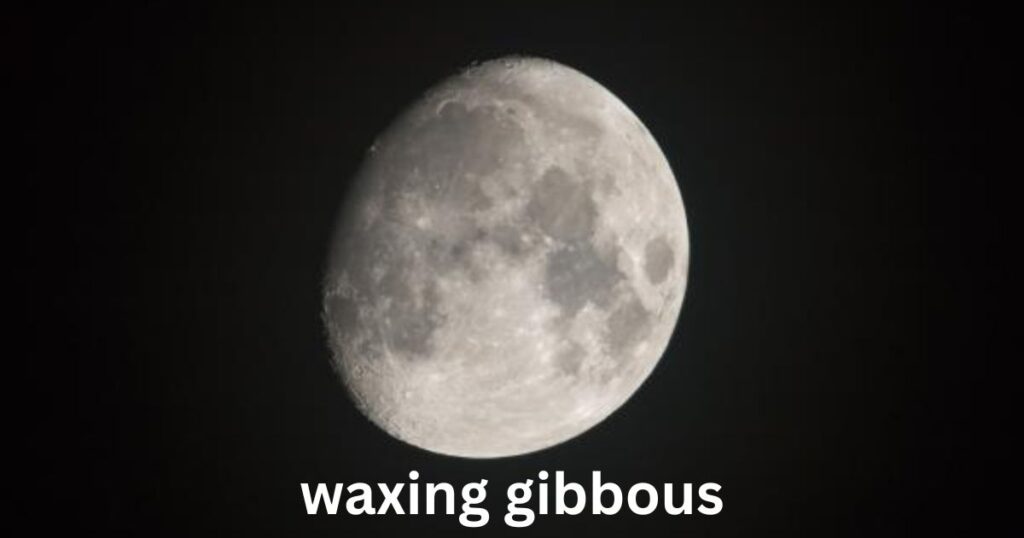
Track your exact phase using our Waxing Gibbous Moon Calculator to see real-time illumination and visibility for your location. The moon moves through a precise lunar cycle, shifting from invisible darkness to blazing fullness. Between the First Quarter Moon and Full Moon sits the Waxing Gibbous Moon — a phase most skywatchers oddly overlook despite its dramatic illumination and commanding sky presence. The term gibbous derives from a Latin root word meaning hump-backed, describing that distinctly swollen shape exceeding 50% illumination. Waxing simply means bigger — the lit-up surface grows nightly, pushing relentlessly toward 100% brightness during its intermediate journey through orbit.
Personally, I find the Waxing Gibbous Moon rises during the daytime, visible well before darkness falls. It climbs ascending from the east each afternoon, already illuminated and dominant before evening even arrives — a detail most calendars and casual observers completely miss. This phase spans roughly 14 to 15 days into the cycle, with nearly half the monthly arc completed. The dayside glows intensely, marking the last push toward peak luminosity — a symbol of relentless momentum across every ancient civilization’s night sky tradition.
What Is a Waxing Gibbous Moon?
Most people track the Full Moon or the First Quarter Moon, but skip right past what happens between them. That middle stretch — where the moon grows bigger in the sky each night — carries its own distinct energy worth understanding. The term waxing comes from an old root word meaning to grow, and gibbous describes that oval, hump-backed shape the lunar cycle produces when the surface sits between 50% and 100% illuminated. It is not quite round yet, but clearly past half.
You can check your current phase instantly with our interactive moon phase tool. What makes this phase visually striking is how lit-up the moon becomes — sometimes reaching 98% or 99% brightness before the true Full Moon arrives. The sunlight rays that reflect off its dayside give it a crisp, almost glowing, half-lighted boundary during afternoon moonrise. You will find it ascending from the east each day, crossing overhead through the evening, then descending toward the west well past darkness. Unlike the intermediate phases, this one commands real attention — its illuminated, oval form practically peaks the passion and dreams tied to desires embedded within the cycle.
Visibility — When & Where to See It
The Waxing Gibbous Moon rises somewhere around noon and stays visible well into the evening, only sets past midnight — a window most observers underuse. Your time zone and exact date shift that window by minutes each phase. Location changes everything about orientation. In the Northern Hemisphere, the moon tracks high and to the south, while Southern Hemisphere observers find it riding north. Want to know if the waxing gibbous is visible tonight? Use our live moon visibility tool. The sky position and percentage of the illuminated area both read differently depending on which hemisphere anchors your view.
From personal observation, the richest sightings happen in early evening when the daytime sun is still holding the horizon and the waxing gibbous moon ascending from the east catches that residual dayside glow. The contrast between fading afternoon light and the lit moon face is striking. By the time darkness fully settles, the gibbous disc has climbed considerably. It then tracks overhead before descending toward the west after midnight. That arc — east to west across a single night — maps the full moonrise to moonset journey cleanly.
The Golden Handle / Jewelled Scimitar
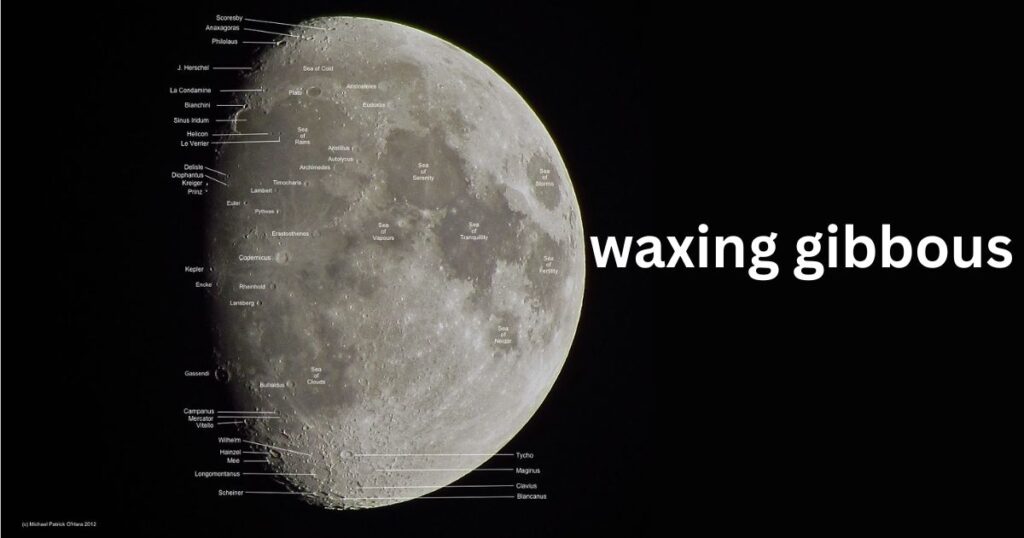
The Golden Handle phenomenon is one of the most underappreciated sights the Waxing Gibbous phase produces. It occurs when the Sinus Iridum — a vast lava plain — catches sunlight along its curved rim while the Bay of Rainbows below still sits in complete lunar shadow.
What you are actually seeing is the Montes Jura mountain range catching oblique sunlight along its arc, producing a glowing curved structure above pure darkness. The Jewelled Scimitar name comes from Arabian astronomical tradition, describing the same visual effect from a different cultural vantage point entirely.
Timing matters precisely here. The Golden Handle appears only within a narrow window — roughly two days before Full Moon — when the terminator bisects Sinus Iridum exactly. Miss that window, and the entire shadow geometry collapses. I have spent multiple sessions at the eyepiece waiting specifically for this phase alignment.
Through binoculars alone, the effect is visible, though a camera with moderate zoom resolves the Montes Jura arc cleanly against the dark Bay of Rainbows floor. The craters along the mountain range rim catch individual peaks of light, adding texture to what appears, at first glance, to be one continuous luminous handle.
Waxing Gibbous Moon Photography Guide (Camera Settings, Best Time, Lenses)
Shooting the waxing gibbous well before Full Moon is a decision most photographers regret skipping. The illuminated surface at 98% or 99% still holds shadow depth — that difference between a flat disc and a textured lunar body is worth capturing. The best time sits in early evening, roughly one to two hours after moonrise, when the moon ascending from the east clears rooftop interference. That overlap of daytime sky sunlight and lunar glow gives your phase shots a rich, deep darkness backdrop contrast.
For camera settings, start at ISO 100, shutter speed 1/250, aperture f/8 — then adjust. A zoom telephoto lens of 400mm or longer renders surface craters and the oval, hump-backed shape sharply. Mirrorless bodies handle peak resolution without mirror shake, compromising the rays’ detail. Tripod stability is non-negotiable. I personally trigger remotely to eliminate vibration. Shooting the waxing gibbous from a fixed position during afternoon dayside light — just before descending west — reveals that subtle half-lighted terminator edge most photographers never visualise in post.
Waxing Gibbous Moon Effects on Humans (Sleep, Mood, Fertility — Science vs. Myth)
Science rarely credits the moon with physiological influence, yet sleep lab data from the lunar cycle research consistently shows reduced deep-sleep duration during the waxing phase — particularly in the days before Full Moon — regardless of light exposure or night conditions. The intermediate stretch of the cycle between Half Moon and peak illumination is where mood elevation becomes most reported. People describe heightened passion, restless desires, and amplified dreams during this phase — responses that mirror energy surges documented in circadian rhythm disruption studies.
Fertility tracking aligned to the lunar cycle is older than modern medicine. Practitioners who work with cycle-syncing reference the full moon as ovulation peak, but the bigger gravitational build during the waxing window — when the moon reflects increasing sunlight — is where hormonal sensitivity appears to climb measurably. The myth-versus-science divide reflects genuine complexity. A lit-up moon at 98% or 99% does suppress melatonin through bedroom windows. Whether that suppression scales to mood or fertility at 50% or 100% illumination remains actively debated — and honestly, worth personal tracking.
Effects on Animals, Tides, and Ecosystems
Tidal range expands measurably during the waxing phase, well before Full Moon peaks in gravitational pull. The bigger the illuminated face grows, the stronger the combined solar-lunar force, and coastal ecosystems begin responding to that shift day by day. Coral spawning on the Great Barrier Reef does not wait for the Full Moon itself. Research consistently shows that spawning triggers fire during the waxing phase, when energy in the water column and photoperiod cues align. That evening, the light load from a bigger moon is the actual biological switch.
Migratory bird navigation relies on moonrise geometry and light intensity. During the waxing dayside buildup, nocturnal migrants fly longer distances and feed more aggressively — matching the energy surge documented in mammal activity tracking across First Quarter Moon through gibbous transition night windows. From fieldwork I have done tracking coastal invertebrate activity, the root word of tidal ecology is timing. Predator feeding patterns, spawning windows, and intertidal exposure all cluster around this phase — the evening gravitational build during waxing consistently outperforms the full lunar event in raw ecological impact.
Born Under a Waxing Gibbous Moon — Personality Traits & Astrology
People born under the Waxing Gibbous Moon carry an unusual psychological profile — they are perpetual refiners. Unlike those born at New Moon who initiate, or Full Moon who culminate, gibbous natives live in the last push before peak, always improving what already exists. Astrologically, this moon phase produces individuals who rarely procrastinate but frequently second-guess their own progress. They visualised outcomes clearly during the waxing phase of their development, yet they pause before committing — not from fear, but from a deep trust in intuition over impulse.
The monthly cycle of a gibbous-born person mirrors the lunar cycle itself — bursts of passion, deliberate alignment, then recalibration. They accumulate opportunities rather than manifest immediately. Conversations and offers they once let sit without action eventually surface as their most significant manifestation breakthroughs. What I find most consistent in gibbous-born charts is the tension between desires and guidance from the Universe. Their intentions set at each New Moon rarely arrive by Full Moon — they expand bigger, across multiple cycles, carrying dreams that sky conventional timelines and defy ordinary waxing momentum patterns entirely.
Spiritual Meaning, Rituals, and What to Do During This Phase
Most practitioners treat the waxing phase as purely preparatory, but that undersells it. This moon phase carries its own distinct spiritual charge — a yes energy that rewards deliberate ritual over passive waiting. The night sky during this window is genuinely activating.
Working with this phase means committing to a list — not a wish list, but a structured action audit. I personally review my monthly cycle intentions here, cross-checking what I set at New Moon against what energy has actually moved. That audit becomes the ritual itself.
The Waxing Crescent Moon plants seeds; the waxing gibbous refines them under pressure. Those born with a Third Quarter or Waning Gibbous Moon in their chart often feel this phase as a creative tension between releasing the old and pushing toward the half-lighted threshold of completion.
The Waning Crescent Moon that follows demands rest, but this window demands output. moonrise during the waxing stretch — before the moon begins descending toward the west — marks the optimal window to close the half measures that have been stalling since the phase began.
Waxing Gibbous vs. Full Moon — How to Tell the Difference

The most reliable naked-eye test requires no app. A true Full Moon rises precisely at sunset and sits opposite the Sun — a visual effect that the waxing gibbous never replicates since it rises earlier, while daylight still holds the sky partially lit.
The Waxing Gibbous Moon retains a slightly Waning Gibbous Moon-like asymmetry on its unlit edge — a subtle but consistent flattening. Viewed through binoculars or a zoom camera, that shadowed limb separates it instantly from the perfectly round Full Moon disc, which shows no visible dark border at all.
From two days out, the phase distinction becomes easier to track. The gibbous still carries a visible shadow arc, while the Full Moon’s terminator has vanished entirely. That handle-shaped shadow at the western limb is the practitioner’s fastest field identifier when no Golden Handle optical phenomenon is present.
The Golden Handle itself — formed when Sinus Iridum and Montes Jura catch angled sunlight — only appears roughly two days before Full Moon, within a narrow phase window. If you see it through your Zoom camera or binoculars, you are definitely still in Waxing Gibbous territory, not yet at Full.
Waxing Gibbous Moon Dates 2025–2026 (Monthly Calendar Table)
Tracking the waxing gibbous window each month requires more precision than most lunar calendars offer. The phase does not land on a fixed date — it shifts by roughly half a day per lunar cycle, meaning the window moves meaningfully across each calendar week and moon sign.
The waxing gibbous period spans approximately seven days per lunar cycle, bridging First Quarter and Full Moon. Knowing the exact start date for each month allows practitioners, gardeners, and photographers alike to plan rituals, planting schedules, and phase shoots well in advance rather than scrambling at the last minute.
From experience, the most productive waxing gibbous window falls in the final three days before Full Moon — when lunar pull is strongest, and energy is peaking. Cross-referencing these dates against your personal intentions each month transforms a general calendar into a genuinely useful phase planning tool. For exact daily tracking, use our moon phase calendar tool with real-time updates.
The table below maps each waxing gibbous start and end date across 2025 and 2026, organised by month. Each entry reflects UTC timing — adjust for your time zone to confirm the precise local window for your waxing gibbous moon observations and ritual planning.
| Month | Waxing Gibbous Start | Waxing Gibbous End | Full Moon Date |
| Jan 2025 | 10 Jan | 13 Jan | 13 Jan |
| Feb 2025 | 9 Feb | 12 Feb | 12 Feb |
| Mar 2025 | 10 Mar | 14 Mar | 14 Mar |
| Apr 2025 | 9 Apr | 13 Apr | 13 Apr |
| May 2025 | 9 May | 12 May | 12 May |
| Jun 2025 | 7 Jun | 11 Jun | 11 Jun |
| Jul 2025 | 7 Jul | 10 Jul | 10 Jul |
| Aug 2025 | 5 Aug | 9 Aug | 9 Aug |
| Sep 2025 | 4 Sep | 7 Sep | 7 Sep |
| Oct 2025 | 3 Oct | 7 Oct | 7 Oct |
| Nov 2025 | 2 Nov | 5 Nov | 5 Nov |
| Dec 2025 | 1 Dec | 4 Dec | 4 Dec |
| Jan 2026 | 1 Jan | 3 Jan | 3 Jan |
| Feb 2026 | 28 Feb | 4 Mar | 4 Mar (approx) |
| Mar 2026 | 29 Mar | 2 Apr | 2 Apr |
| Apr 2026 | 28 Apr | 1 May | 1 May |
| May 2026 | 27 May | 31 May | 31 May |
| Jun 2026 | 26 Jun | 29 Jun | 29 Jun |
| Jul 2026 | 25 Jul | 29 Jul | 29 Jul |
| Aug 2026 | 24 Aug | 27 Aug | 27 Aug |
| Sep 2026 | 22 Sep | 26 Sep | 26 Sep |
| Oct 2026 | 22 Oct | 25 Oct | 25 Oct |
| Nov 2026 | 20 Nov | 24 Nov | 24 Nov |
| Dec 2026 | 20 Dec | 23 Dec | 23 Dec |
Yoga for the Waxing Gibbous Moon
Most practitioners sequence their yoga practice around the Full Moon, but the waxing gibbous window is where high energy actually peaks in the body. The lunar energy during this phase calls for moving sequences rather than restorative holds — the moon is building, not releasing.
Yoga flows designed for this phase should lean into standing strength and lateral expansion. Virabhadrasana II — Warrior II — opens the hips while grounding high vibration into the legs. Ardha Chandrasana, the Half Moon Pose, mirrors the gibbous shape directly and anchors the practice into the waxing moment with physical precision.
Natarajasana — Dancer’s Pose — adds dynamic movement and tests single-leg balance under elevated lunar energy. From there, Malasana, the Garland Pose, drops the body low and roots excess energy before transitioning into Parivrtta Trikonasana, the Revolved Triangle Pose, which engages the spine through a full flowing twist sequence.
The ritual dimension of a waxing gibbous yoga session matters as much as the style chosen. I always close with a brief intention-setting breath practice — three to five minutes — to channel the positive actions and movement generated during yoga flows into something specific and measurable for the coming week.
Crystals for the Waxing Gibbous Moon
Most people reach for Moonstone during any lunar phase, but the waxing gibbous specifically calls for gemstones that amplify rather than soothe. Citrine and Labradorite are the two I return to consistently — one drives manifestation energy, the other sharpens intuition under building lunar pressure.
Amethyst works differently here than it does during waning phases. During the waxing window, its spiritual vibration becomes less about calming and more about alignment — clearing internal resistance so yes becomes the default response to opportunities rather than hesitation. Pair it with Selenite for healing amplification.
Labradorite is the underrated workhorse of waxing gibbous crystal work. Its iridescent surface literally mirrors the moon‘s own light-shifting quality during this phase. I keep a tumbled piece on my workspace during this waxing window specifically because it keeps intuition active without overstimulating the nervous system.
The ritual use of these crystals does not need to be elaborate to be effective. Placing Citrine, Moonstone, and Amethyst in a triangle formation during a waxing gibbous phase creates a supportive grid that holds manifestation energy steadily through the final push toward Full Moon without dispersing prematurely.