 Skip to content
Introduction
The waning gibbous moon phase begins right after the full moon, when the illuminated surface gradually starts shrinking. This intermediate stage sits between the full moon and the last quarter moon, appearing as a large oval shape in the night sky. Unlike the 100% brilliance of a full moon, it remains between 98% and 50% illuminated, reflecting sunlight like a natural marker of the lunar cycle.
Most skywatchers observe this phase during late night and early morning hours. Its glow carries a quiet symbolism of awareness and wisdom, often associated with sharing knowledge, gratitude, and reflecting on lessons — a theme deeply explored in both modern astronomy and ancient lunar traditions. As it transitions toward the third quarter moon (also called the last quarter), this phase gently reminds observers to value endings just as much as beginnings.
Quick Fact: The word “gibbous” comes from the Latin “gibbosus”, meaning hump — describing the moon’s distinctive bulging, oval shape when more than half illuminated.
What Is the Waning Gibbous Moon?
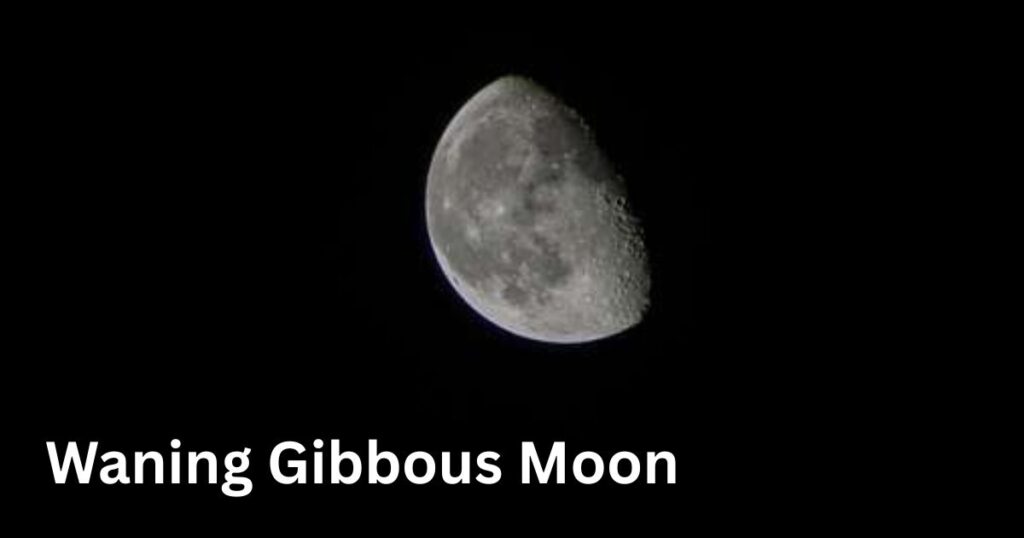
The waning gibbous phase begins the moment the full moon starts to decline, usually between day 15 and 22½ of the 29.5-day lunar month. The illuminated surface slowly reduces from nearly full toward half, without any sudden change. This gradual dimming creates a slightly uneven oval shape, moving steadily toward the third quarter phase.
Waning means the moon is shrinking — getting smaller each night. Gibbous refers to the shape: more than half illuminated but not yet a complete circle. Together, the term waning gibbous describes a moon in visible decline after its peak luminosity.
As it rises later each night, the moon often appears reddish near the eastern horizon around sunset — a result of atmospheric refraction — and becomes pale by early morning. This phase symbolizes letting go — releasing what has built up during the full moon. Its energy remains strong but declining, like something still bright yet clearly past its peak.
Unlike a waxing gibbous moon (which grows toward fullness), the waning gibbous is moving away from it, making the distinction important for both astronomers and spiritual practitioners who track the lunar calendar.
When Does the Waning Gibbous Moon Rise and Set? / Visibility
During the waning gibbous phase, the moon rises after sunset — typically between sunset and midnight — and continues shifting approximately 50 minutes later each night. Unlike the full moon, which sets near sunrise, this phase stays visible well into the morning hours.
| Day in Lunar Cycle | Moonrise Time (Approx.) | Best Visibility Window |
| Day 15–16 | Just after sunset | Late evening to dawn |
| Day 17–19 | Late evening | Midnight to morning |
| Day 20–22 | Near or after midnight | Pre-dawn to mid-morning |
Its peak visibility occurs between late night and early morning, often appearing beautifully against a soft blue dawn sky. Moonrise and moonset times shift by about 50 minutes daily due to Earth’s rotation and the moon’s orbital movement. The moon typically rises in the east, travels high across the night sky, and sets in the west by morning.
This consistent pattern makes it bright and noticeable, even though it is no longer fully illuminated. Astronomy apps and lunar calendars are helpful tools for tracking exact rise/set times based on your geographic location.
The Waning Gibbous Moon in the Daytime Sky
Many people associate the moon only with nighttime, but the waning gibbous often remains visible long after sunrise — sometimes until midday. It appears faint yet glowing against the blue sky, drifting westward as daylight increases. Because it rises after sunset, it is already high in the sky by morning, making daytime sightings quite common.
From evening through early afternoon, this phase offers extended visibility. It dominates the eastern sky before midnight and gradually shifts westward by morning, sometimes setting as late as midday.
According to NASA Science, the moon is visible in the daytime sky for roughly half of every month — but the waning gibbous is particularly well-suited for morning daytime observation because of its position relative to the Sun. Observing its gradual movement across the daytime sky reveals a steady orbital rhythm that many skywatchers rarely stop to notice.
Understanding Moon Phases: Where Waning Gibbous Fits
The complete lunar cycle spans approximately 29.5 days and includes 8 distinct moon phases:
- 🌑 New Moon
- 🌒 Waxing Crescent
- 🌓 First Quarter
- 🌔 Waxing Gibbous
- 🌕 Full Moon
- 🌖 Waning Gibbous ← You are here
- 🌗 Third Quarter (Last Quarter)
- 🌘 Waning Crescent
The waning gibbous phase reflects a transition from fullness toward release. After the full moon, its light gradually decreases while remaining bright enough to observe clearly — especially during early mornings. Its timing may feel unusual, as it blends nighttime visibility with daytime presence.
This phase also varies in appearance depending on location, though its illumination percentage stays consistent worldwide. Note: There is no official calendar symbol for the waning gibbous moon, as it is considered an intermediate phase between two primary phases.
Symbolically, it represents reflection, wisdom, and letting go — encouraging awareness, personal growth, and acceptance of natural cycles. In the disseminating moon tradition (a term used by astrologer Dane Rudhyar), this phase is specifically linked to the sharing and distribution of knowledge gained during the full moon.
Waning Gibbous Moon: Spiritual Meaning & Symbolism
Across cultures and centuries, the waning gibbous has carried rich symbolic meaning:
Reflection & Gratitude:
Many lunar traditions view this phase as a powerful window for self-reflection and gratitude journaling — a moment to acknowledge what the previous cycle brought before releasing it.
Release & Letting Go:
Spiritually, the waning gibbous is strongly associated with releasing negative patterns, outdated habits, and emotional burdens. Just as the moon sheds its light, this phase invites us to shed what no longer serves us.
Wisdom & Teaching:
In many astrological traditions, people born during the waning gibbous phase are considered natural teachers — individuals with an innate ability to share wisdom, communicate effectively, and understand deep patterns in life.
Disseminating Energy:
Also called the disseminating moon phase, this period is seen as ideal for spreading ideas, having meaningful conversations, and sharing lessons learned — not just for personal growth, but for community benefit.
Orientation / Hemisphere Differences
In the Northern Hemisphere, the illuminated portion of the waning gibbous moon fades from left to right as the phase progresses. In contrast, the Southern Hemisphere experiences the opposite effect, where the light decreases from right to left. This mirrored appearance often surprises those observing from different parts of the world.
The orientation of the lit portion also depends on additional factors: the time of night, your latitude, and the moon’s altitude above the horizon — meaning the same moon can appear tilted differently even within one hemisphere.
Despite these visual differences, the lunar cycle remains the same globally, following its consistent 29.5-day orbit. The same percentage and area of the Moon is illuminated no matter where on Earth you stand — only the angle of observation changes.
Understanding these variations helps explain why the moon can feel visually different depending on geographic location, even though it is fundamentally the same phase everywhere.
Frequently Asked Questions (FAQ)
Q: How long does the waning gibbous moon last?
The waning gibbous phase lasts approximately 6 to 7 days, from the day after the full moon until the third quarter moon.
Q: What is the difference between waxing gibbous and waning gibbous?
A waxing gibbous moon is growing toward a full moon (illumination increasing), while a waning gibbous moon is shrinking away from it (illumination decreasing).
Q: Is the waning gibbous moon visible every night?
Yes, barring cloud cover. It rises after sunset and remains visible through the night and into the morning — often visible in the daytime sky as well.
Q: What does the waning gibbous moon mean spiritually?
Spiritually, the waning gibbous is associated with gratitude, reflection, release, and wisdom — a time to let go of what no longer serves and prepare for the next lunar cycle.
Q: Can I see the waning gibbous in both hemispheres?
Yes, but its orientation appears mirrored. In the Northern Hemisphere, the shadow falls on the left side; in the Southern Hemisphere, it falls on the right.